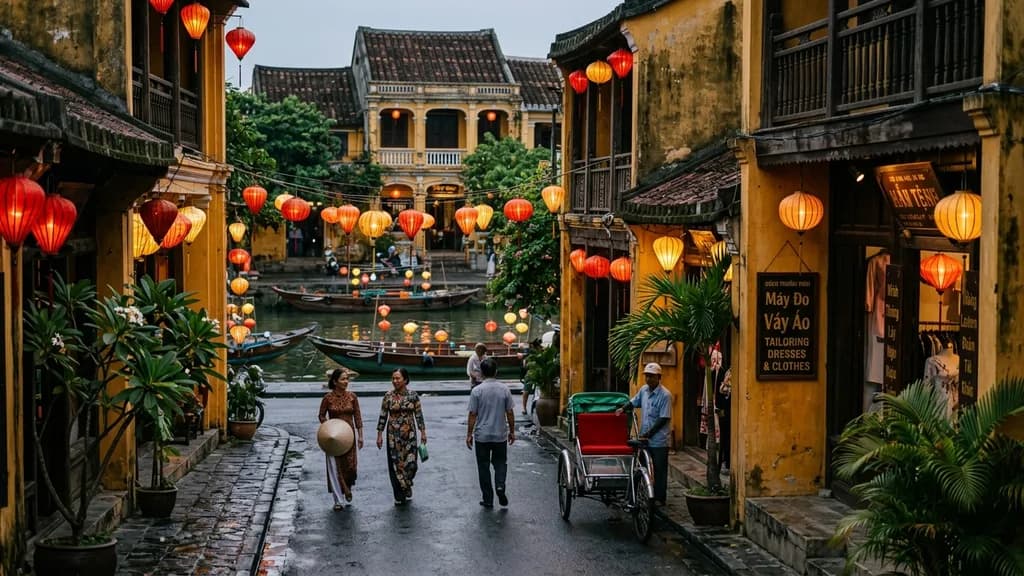
Hoi An shows up on nearly every Vietnam itinerary, and for good reason. A UNESCO-listed 15th-century trading port, a lantern-lit old quarter, a tailoring industry the rest of the world cannot match on price, and a beach ten minutes away by bicycle. It sounds like a travel-magazine fantasy.
It also sounds, to anyone who has actually been there between 11am and 6pm in October, like a warning. Tour buses empty out, umbrella-led groups fill the narrow lanes, every third shopfront is selling the same printed souvenirs, and the Japanese Bridge disappears behind a wall of phones.
So is Hoi An worth visiting in 2026 or not? This is the honest, decision-frame answer: when it shines, when it disappoints, what the tailor experience really costs, how the weather and typhoon seasons change the math, and how many nights you need to make it work. If you want the full packing-and-logistics version, see our Hoi An travel guide. If you are specifically here for the tailoring question, our Hoi An tailors guide goes deeper on shops and timelines.
TL;DR: The One-Line Verdict
Yes, if you stay three to four nights and visit the ancient town at dawn or late evening. No, as a rushed day trip in the middle of the day.
Everything below is the reasoning behind that single sentence. If you are the kind of traveler who wakes up early and chooses atmosphere over box-ticking, Hoi An is probably the most memorable stop on your Vietnam trip. If your plan is "get in at noon, walk the old town, drive back to Da Nang for dinner," skip it and spend the day at the beach instead. You will not enjoy it, and that says more about the timing than about Hoi An.
The Crowd Reality (And the Dawn Strategy)
Let us get this out of the way first, because it shapes every other decision. The ancient town of Hoi An is genuinely crowded. On a typical peak-season afternoon (October through early December), foreign and domestic tourists make up roughly 60% of everyone walking the streets. Cruise-ship day-trippers, tour groups from Da Nang, Korean and Chinese package travelers, Western backpackers, and a steady stream of photo-shoot couples all converge on the same 1.5 square kilometers.
If this is all you see, you will not understand why anyone loves Hoi An.
The trick, and the whole reason first-time visitors either fall hard for the town or leave disappointed, is timing.
5:30am to 7am: the magic window. The streets are empty. Local vendors are setting up. Light slants through the tiled roofs at an angle you will not see again all day. The Japanese Bridge is genuinely photographable without cropping people out. This is when Hoi An looks like the postcard.
7am to 10am: quiet and workable. Tourists are still at breakfast. You can walk at a normal pace, sit at a coffee shop on the river, and actually hear birds.
10am to 8pm: peak crowd. Not impossible, but heavy. Worth ducking out to An Bang beach, a tailor fitting, or a siesta at your hotel.
8pm to 10pm: lantern golden hour. Crowded but magical. The lanterns are on, the river boats are lit, and the density of people is part of the atmosphere rather than a problem.
After 10pm: second quiet window. Day-trippers have gone back to Da Nang. The town softens. You can walk the Thu Bon waterfront alone.
Stay overnight and you get access to both quiet windows. Come as a day-tripper and you only see the peak hours. That is the entire argument for spending at least one night, and the reason our answer to "is Hoi An worth it" depends so heavily on how you structure the visit.
The Lantern Magic: Monthly, Not Annual
A common mistake first-time visitors make is assuming the Hoi An Lantern Festival is a once-a-year event. It is not.
Every night, Hoi An's ancient town is lantern-lit. Silk lanterns hang from every shopfront, river boats carry small candles, and vendors sell floating paper lanterns for a few thousand dong. This happens 365 days a year and is part of what gives the town its signature look.
On the 14th night of every lunar month, the full Lantern Festival happens. Electric lights across the old quarter are switched off. Only silk lanterns, candles, and the moon illuminate the streets. Traditional music performances pop up along the river, and the atmosphere shifts from "pretty tourist town" to "something genuinely unusual." Because this follows the lunar calendar, the dates move around in the Gregorian calendar, but it works out to roughly once a month.
Lantern Nights Quick Reference
| Event | Frequency | What changes |
|---|---|---|
| Standard lantern evening | Every night | Lanterns lit from dusk, normal street lighting on |
| Full Lantern Festival | 14th night of each lunar month | Electric lights off, candles and silk only, music and performances |
| Tet (Lunar New Year) | Once per year (Jan or Feb) | Extra decorations, big crowds, some shops closed |
| Mid-Autumn Festival | 15th night of 8th lunar month | Child-focused lantern parades |
If your dates are flexible, aligning a Hoi An overnight with a 14th-of-the-lunar-month date is one of the highest-leverage travel-planning moves in Vietnam. For a guided version, GetYourGuide lists Hoi An lantern boat tours that include a small river boat and candle release, which is a touristy but genuinely pretty experience.
The Tailor Verdict: What You Actually Get
This is the other reason people come to Hoi An, and it is the area where expectations are most often wrong in both directions. Some visitors think they will walk out with a Savile Row suit for $40. Others assume everything is junk. Neither is right.
The town has more than 250 active tailor shops. The quality spread is enormous, and the price you pay correlates with what you get more than many travelers expect.
Tailor Price Tiers
| Tier | Price range (USD) | What you should expect | Realistic turnaround |
|---|---|---|---|
| Budget ($30-60 suit) | Bottom 40% of shops | Machine-cut pattern, thin fused linings, light fabric, visible finishing issues within a year | 24 hours, one fitting |
| Mid ($80-150 suit or dress) | Top-tier street shops | Decent fabric, mostly machine construction, good fit after two fittings, wearable for several years | 36-48 hours, two fittings |
| Premium ($180-350+) | Known names like Yaly, Be Be, A Dong Silk | Canvassed construction in top options, proper fabric weight, hand-finished details, fit comparable to Western mid-range bespoke | 48-72 hours, two to three fittings |
Compared to a $500 off-the-rack suit in London or New York, even the premium tier is cheap. Compared to $3000+ true bespoke, it is still not the same product. A fair mental model: Hoi An premium tailoring is closer to a quality made-to-measure experience at a fraction of the price, not full bespoke.
Practical rules if you are actually going to order something:
- Allow at least 48 hours in town. One fitting is almost never enough. Two is the minimum for a decent outcome.
- Bring a reference garment. A jacket or dress that fits you well, even if it is an old one, gives the tailor something concrete to measure against.
- Budget $120-200 for something you will wear at home. Below that, the fabric and construction will not survive a London winter or a dry-cleaner visit.
- Skip the "suit, shirt, tie, and shoes for $60" combo deals. The maths does not work, and the finished product reflects that.
For the deep dive on specific shops, fabric choices, and how to handle fittings, see our Hoi An tailors guide.
Beach Access: An Bang vs Cua Dai
Hoi An is technically a beach destination. Whether it actually delivers on that depends on which beach you choose and which year you come.
An Bang beach is the winner for most travelers. It is roughly a 10-minute cycle or 15-minute Grab ride from the ancient town, the sand is still wide and usable, and there is a cluster of casual beach cafes and restaurants that work for long afternoons. Sun loungers typically cost 50,000-100,000 VND (USD 2-4) or come free with food and drink orders. The swimming is best from March through August when seas are calm.
Cua Dai beach is the other main option, about 15 minutes from town, and it comes with an asterisk. Coastal erosion has been severe over the past decade. Several large resorts that once had wide private beaches now have sea walls right up against the hotel grounds. Parts of Cua Dai are still usable, but the experience is inconsistent, and if you are picturing a wide soft-sand beach day, An Bang is the safer call.
In monsoon and typhoon months (September through November), neither beach is a swimming destination. Strong currents, red warning flags, and often closed loungers. Beach days in that window are for walking, not swimming.
Da Nang and Day-Trip Territory
One of the big quiet advantages of basing yourself in Hoi An is the density of worthwhile day trips in the surrounding Quang Nam and Da Nang area.
Da Nang itself is roughly a 30-minute drive north. It is a modern beach city, Vietnam's fifth largest, and in some ways the opposite of Hoi An: wide boulevards, tall buildings, long straight beaches, and the Dragon Bridge that breathes fire on weekend nights. Half a day in Da Nang is a nice palate cleanser if the ancient town starts to feel like too much. The beaches (My Khe especially) are longer, cleaner, and less eroded than Cua Dai.
My Son Sanctuary is about an hour southwest by road. These are the ruined brick temples of the Cham civilization, a UNESCO site, and a half-day trip if you go early to beat both heat and crowds. It is not Angkor, but it is genuinely atmospheric if you are interested in pre-Vietnamese Southeast Asian history. Viator runs small-group My Son tours from Hoi An that bundle transport and a guide, which is the path of least resistance.
Marble Mountains sit between Hoi An and Da Nang, maybe 30 minutes from town. Five limestone hills with caves, Buddhist shrines, and panoramic viewpoints. Easy to combine with a Da Nang half-day or a morning trip on your own by Grab.
Day-Trip vs Overnight: The Actual Difference
If you are choosing between a Hoi An day trip from Da Nang and a multi-night stay, this is the blunt comparison.
Day Trip vs 3-Night Stay
| Factor | Day trip (5-7 hours) | 3-night stay |
|---|---|---|
| Ancient town at dawn | No | Yes (the highlight for most travelers) |
| Ancient town after 10pm | No | Yes (second quiet window) |
| Lantern evening | Brief, often rushed back to Da Nang by 9pm | Full evening, optionally multiple |
| Realistic tailor order | No (too short for fittings) | Yes (48 hours is enough for mid-tier) |
| Beach day at An Bang | Usually skipped | Easy to include |
| My Son or Marble Mountains | Not combinable | Easy add-on |
| Crowd experience | Peak hours only, worst version | Full range, including the quiet windows |
| Typical cost | Lower total, higher cost-per-hour | Higher total, better value per hour |
The day-trip column is not wrong, it is just a much weaker version of the destination. You see the postcard version of Hoi An, at the worst possible time, and miss everything that makes people actually remember it.
Food Musts: The Three You Should Not Miss
Central Vietnamese food is different from Hanoi or Ho Chi Minh City, and Hoi An is arguably its best single showcase. Three dishes in particular are worth planning around.
Banh mi Phuong is the most famous banh mi shop in Vietnam, partly because Anthony Bourdain filmed there and partly because Barack Obama stopped by. It is still genuinely good. Expect a 10-20 minute queue at peak hours. The pork-and-pate combo with crispy baguette is the benchmark. Locations: 2B Phan Chu Trinh, central old town.
Cao lau is the Hoi An specialty noodle dish. Thick, chewy noodles (traditionally made with water from a specific local well), slices of roast pork, fresh herbs, crunchy rice crackers, and a small amount of savory broth that is more dressing than soup. You will find it everywhere in town, and a decent bowl costs 40,000-70,000 VND (USD 1.50-3).
White rose dumplings (banh bao banh vac) are a delicate local dumpling shaped like a rose petal, filled with shrimp or pork, topped with crispy shallots. Lightly steamed, always served cold-to-warm, and the kind of dish that only makes sense in Hoi An.
A single day of eating in Hoi An will cost 200,000-400,000 VND (USD 8-16) per person at local places, significantly more at the riverside tourist restaurants. Skip the laminated-menu places along the Thu Bon, walk two streets back, and prices drop by half.
Typhoon Season: The Risk You Should Not Ignore
The single most underrated piece of Hoi An travel planning is the typhoon calendar. Central Vietnam's weather is not evenly distributed across the year, and the wet end of it is genuinely disruptive.
February to April: the ideal window. Dry, mild (22-28°C), sunny days, calm seas, low humidity. If you can choose your dates, this is when Hoi An is at its best.
May to August: hot and bright. Temperatures climb to 33-37°C, humidity is high, but rainfall is lower than many tropical destinations in this window. Beach weather. Early mornings are the friendliest.
September to November: typhoon and flood risk. Tropical storms make landfall along the Central Vietnam coast regularly in October and November, and the Thu Bon river routinely floods into the ancient town. In severe years, the lower streets are only navigable by boat, several tailors close, and some hotels move guests to higher floors. Flights into Da Nang get cancelled. This is not every year, and not every week, but the risk is high enough that travel insurance is non-negotiable for this window.
December to January: dry but cooler. Pleasant for walking, occasionally cool enough for a light jacket in the evening, seas can be rough for swimming. Busy with domestic tourism around Tet.
If your only possible dates are October or early November, still go (the atmosphere between storms can be beautiful with low crowds), but build in flexibility and do not book a non-refundable tailor order you might not be in town to collect.
Ideal Length of Stay: The 3-4 Night Sweet Spot
Putting all of this together, the optimal length of stay in Hoi An for most 2-week Vietnam itineraries is three to four nights.
- One night: Enough for one dawn walk and one lantern evening. Rushed. No realistic tailor order, no beach day, no day trips.
- Two nights: Workable. Enough for a tailor fitting cycle if you arrive by lunchtime on day one. No buffer if weather is bad.
- Three nights: The sweet spot. One beach day, one tailor cycle with two fittings, one day trip (My Son or Marble Mountains), both quiet-window dawns, two lantern evenings.
- Four nights: Great if you are also doing Da Nang and My Son. Starts to feel repetitive beyond this unless you are actively working or resting.
- Five+ nights: Only for travelers using Hoi An as a slow-travel base. Digital nomads, writers, retirees. Most first-time visitors will get itchy by day five.
For context on how this fits into a full trip, see our Vietnam 2-week itinerary and the broader first-time Vietnam guide.
Final Answer: Is Hoi An Worth It in 2026?
Yes, with conditions.
Hoi An is worth visiting in 2026 if you stay at least three nights, commit to at least one dawn walk, eat at local places rather than the riverside tourist traps, and either plan around the 14th-of-the-lunar-month lantern festival or simply accept the standard lantern evenings which are still beautiful. Add a tailor order if you have the budget for the $120-200 mid-tier, and pair Hoi An with Da Nang or My Son to vary the experience.
It is not worth visiting in 2026 if you plan to rush in from Da Nang for five hours during peak hours, come during October-November without weather-flexible plans, expect $30 to get you a quality suit, or dislike crowds enough that even the 8-10pm lantern density will bother you.
The town is not what it was in 2005, when the streets were quieter and tailor prices were lower. It is also not ruined. It is a heavily touristed UNESCO site that, at the right hours and with the right expectations, still delivers one of the most atmospheric experiences in Southeast Asia. Timing is the whole game. If you get that right, Hoi An will likely be the stop you remember most from your Vietnam trip.
Bronnen & Referenties
Dit artikel is gebaseerd op eigen ervaring en geverifieerd met de volgende officiële bronnen:

Vietnam verkennen sinds 2020 | 40+ provincies bezocht | Maandelijks bijgewerkt
Wij zijn een team van reisschrijvers en Vietnam-liefhebbers die het land het hele jaar door verkennen. Onze gidsen zijn gebaseerd op eigen ervaring, lokale kennis en geverifieerde officiële bronnen.
Meer over ons →Anderen lezen ook

Ninh Binh Guide: Tam Coc, Trang An & Mua Cave – Vietnam's Hidden Gem
Complete Ninh Binh travel guide: explore Tam Coc, Trang An, and Mua Cave. Includes itineraries, where to eat, stay, and insider tips.

Phong Nha Caves Guide: Son Doong, Paradise Cave & More
Complete guide to Phong Nha Caves including Son Doong, Paradise Cave & more. Prices, operators, booking tips & honest reviews.

Hoi An Travel Guide: Ancient Town, Beaches & Tailors
Complete Hoi An travel guide: ancient town, pristine beaches, world-class tailors & local food. Includes 1-day & 3-day itineraries.

Vietnam E-Visa 2026: How to Apply, Costs & Processing Time
Complete guide to Vietnam e-visa in 2026: step-by-step application, exact costs, processing times, and common mistakes to avoid.
Plan Your Vietnam Trip
Book hotels, transport, activities, and get connected with an eSIM
Some links are affiliate links. We may earn a commission at no extra cost to you.