
Vietnam Currency Guide: Dong Notes, ATMs, Cards and Cash
Vietnam's currency is the Vietnamese dong (VND, locally abbreviated “đ”): prices and everyday payments should be in dong. The SBV reference rate on October 23, 2026 was 25,627 VND per USD, or roughly 25,600; it changes daily. Keep cash for small purchases and use a card at larger businesses that accept it.
The Vietnamese dong in one minute
The State Bank of Vietnam (SBV) is the sole issuer of Vietnam currency. VND and đ refer to the same money, so a price written 100,000 VND or 100,000đ uses the same unit. The big numbers take a little practice; count the zeros before handing over a note.
A useful arrival plan is to get some dong, keep smaller denominations separate, and carry a backup payment method. Before a large purchase, confirm the full amount in VND and the payment method the business accepts.
For trip planning beyond money, use the first-time Vietnam guide. This page explains how to recognize and pay with dong; the Vietnam daily budget breakdown covers what to set aside for accommodation, meals, and transport.
Banknotes and coins you will handle
Start by learning the six polymer denominations listed by the SBV. Read the printed value first, then use color and the picture on the back as extra checks. Color alone is a poor way to choose a note in a dim restaurant or a busy queue.
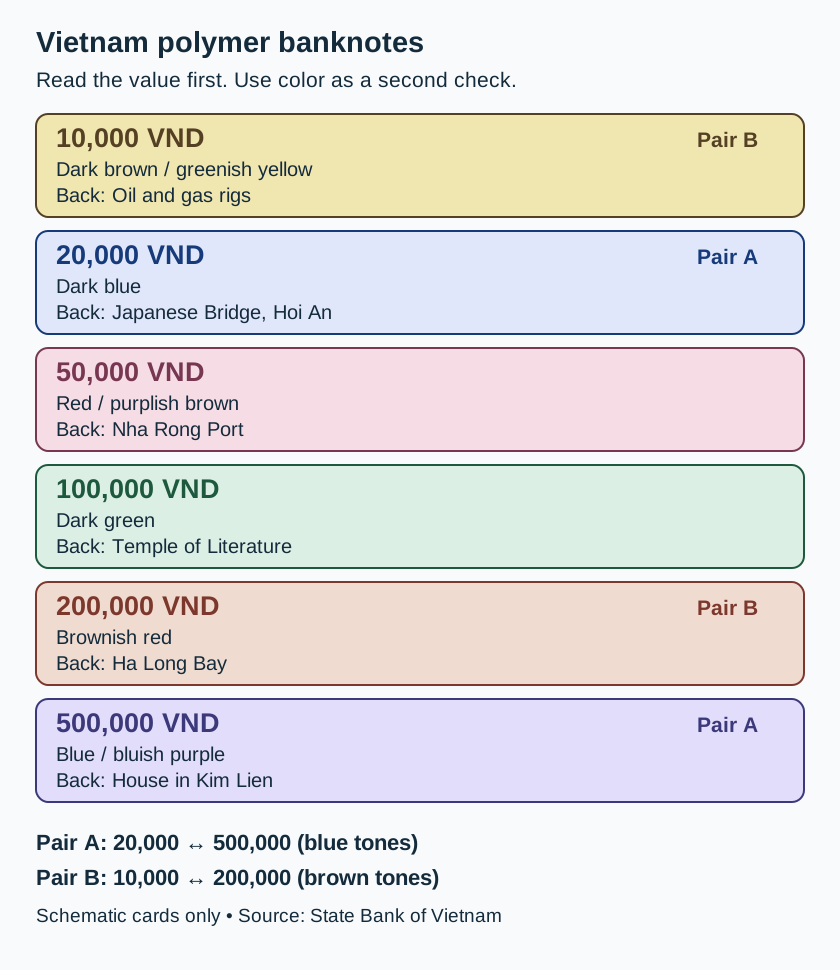
| Value in VND | Material | SBV color description | Picture on the back |
|---|---|---|---|
| 10,000 | Polymer | Dark brown on greenish yellow | Oil and gas rigs |
| 20,000 | Polymer | Dark blue | Japanese Bridge, Hoi An |
| 50,000 | Polymer | Red and purplish brown | Nha Rong Port |
| 100,000 | Polymer | Dark green | Temple of Literature |
| 200,000 | Polymer | Brownish red | Ha Long Bay |
| 500,000 | Polymer | Blue and bluish purple | Ho Chi Minh's house in Kim Lien |
Two pairs deserve extra attention. 20,000 and 500,000 VND both have blue tones, but the larger note is worth 25 times as much. 10,000 and 200,000 VND both include brown tones, with a twentyfold difference in value.
Keep your 500,000 VND notes apart from the 20,000 VND notes. When paying, say the amount or show it on a calculator, and check your change before putting it away.
The SBV also lists cotton-paper notes still in circulation: 5,000, 2,000, 1,000, 500, 200, and 100 VND. Issued coins have values of 5,000, 2,000, 1,000, 500, and 200 VND.
Reading prices and doing the maths
In price shorthand, k means thousand: 50k means 50,000 VND. A price written as 50.000 VND also means fifty thousand dong. If a menu leaves out the unit or the zeros, confirm the total before ordering.
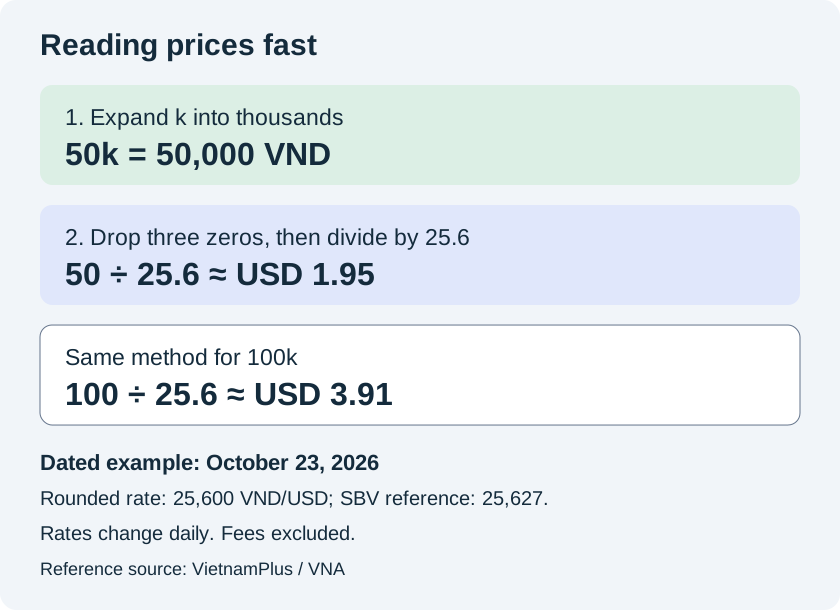
Schematic diagrams; USD examples use 25,600 VND per USD, rounded from the October 23, 2026 reference rate. Rates change daily; fees are excluded.
For a rough USD estimate using that dated rate, drop three zeros and divide by 25.6. That turns 50,000 into 50 ÷ 25.6, or about USD 1.95. Remember to divide after dropping the zeros.
| Example price | Read it as | Approximate USD on October 23, 2026, using 25,600 VND/USD |
|---|---|---|
| 20k | 20,000 VND | $0.78 |
| 50k | 50,000 VND | $1.95 |
| 100k | 100,000 VND | $3.91 |
| 500k | 500,000 VND | $19.53 |
| 1,000k | 1,000,000 VND | $39.06 |
The reference rate reported by VietnamPlus/VNA is a benchmark. A bank or exchange counter uses its own retail rates, and fees can change the amount you receive. Check the actual quote when you exchange.
Dong or US dollars?
Use dong for spending. Vietnam's foreign-exchange rules generally prohibit businesses from advertising or listing prices, or accepting payment, in foreign currency, subject to legal exceptions. The August 2026 SBV Regional Branch 10 notice reiterates those rules for tourism businesses in Khanh Hoa.
Some hotels or tour providers may show an online price in a foreign currency. Ask for the payable total in VND and confirm the booking's payment terms.
US dollars can serve as backup cash to exchange at a bank or licensed office. They should not be your plan for paying at a market or settling a restaurant bill.
There is no universally cheapest currency to bring. Compare your own bank's foreign spending and withdrawal charges with the exchange quote available to you. Avoid buying dollars solely to change them again into dong without checking the combined cost of both exchanges.
Cash, ATMs and cards
Carry some cash even if you prefer cards. Small dong notes make purchases at street stalls and markets easier; ask about card acceptance before committing to a larger purchase. Keep enough accessible cash for your next expenses rather than relying on one payment method.
Before leaving home, notify your bank of your travel plans if it requires this, check that your card can be used abroad, and save a way to contact the bank if it blocks a transaction.
At an ATM or card terminal:
- Check fees before confirming. The ATM operator and your own bank may each charge. Read the screen and your bank's terms.
- Choose VND when offered a billing currency. Dynamic currency conversion means the terminal or ATM converts the amount into your home currency. This is usually more expensive than letting your card provider handle conversion.
- Read the final amount. If the displayed charge is unclear, cancel and ask for help rather than guessing.
- Check the notes you receive. Count the cash and separate the denominations before your next purchase.
Withdrawal limits and costs depend on the machine and your card. Check both before confirming a withdrawal.
Where to exchange money
Use a bank or a licensed foreign-exchange office. Look for a visible sign identifying an authorized exchange agent, and confirm that the counter is permitted to handle your transaction. Check the license even if the shop offers an attractive rate.
The SBV Regional Branch 10 notice directs travelers to commercial-bank transaction points or licensed agencies. It also cites Decree 340/2025: exchanging foreign currency between individuals or at unlicensed organizations can attract fines of up to VND 100 million, depending on the transaction value.
Before handing over cash, ask:
- What rate applies to the currency I am selling?
- Are there any fees?
- How many dong will I receive in total?
Count the money at the counter and keep the transaction receipt. At the airport, compare the displayed rate and fees; exchanging a small initial amount can cover immediate needs while leaving you time to compare later. Do not assume either the airport or a city counter automatically offers better value.
Avoid private street exchanges and unlicensed offers. For wider advice on handling suspicious offers, see the Vietnam safety guide.
Bringing cash into Vietnam
Under Circular 15/2011/TT-NHNN, Article 2, individuals entering or leaving Vietnam with a passport through international border gates must declare cash above either threshold:
- USD 5,000, or the equivalent in other foreign currencies.
- VND 15,000,000 in dong cash.
The wording is above, not “at or above.” Bank cards and traveler's checks are excluded from this cash-declaration requirement.
Keep a confirmed entry declaration if you declare cash. When leaving with cash above the threshold or above the amount previously declared, Article 3 sets documentation requirements. Depending on the circumstances, these can involve the confirmed entry declaration, an authorized bank's confirmation, or SBV approval. Ask the relevant authorities what your situation requires before traveling with a large sum.
Check current rules before you fly, including the rules for any transit country.
Tipping, briefly
Tipping is not expected but is appreciated in tourist areas. Check whether a service charge is already included before adding anything. Keep a few smaller dong notes if you want to leave a tip, and use the Vietnam cost guide's tipping advice for the site's fuller guidance alongside trip costs.
Sources & References
This article is based on first-hand experience and verified with the following official sources:

Go2Vietnam Team
Exploring Vietnam since 2020 | 40+ provinces visited | Updated monthly
We are a team of travel writers and Vietnam enthusiasts who explore the country year-round. Our guides are based on first-hand experience, local knowledge, and verified official sources.
More about us →People Also Read
Vegetarian and Vegan Vietnam: How to Eat Plant-Based Across the Country
Vietnam is one of Southeast Asia's best countries for vegetarian and vegan travel. Buddhist chay cuisine, specific restaurants, dishes to try, and how to communicate your diet.

Tet in Vietnam 2027: Dates and Travel Tips
Tet in Vietnam 2027 falls on February 6. Check official holiday dates, transport windows, possible closures and practical tips for a respectful visit.

Vietnam E-Visa 2026: How to Apply, Costs & Processing Time
Complete guide to Vietnam e-visa in 2026: step-by-step application, exact costs, processing times, and common mistakes to avoid.

Vietnam E-Visa 2026: How to Apply, Costs & Processing Time
Complete guide to Vietnam e-visa 2026: step-by-step application, exact costs, processing times, and eligibility. Apply online in minutes.
Plan Your Vietnam Trip
Book hotels, transport, activities, and get connected with an eSIM
Some links are affiliate links. We may earn a commission at no extra cost to you.