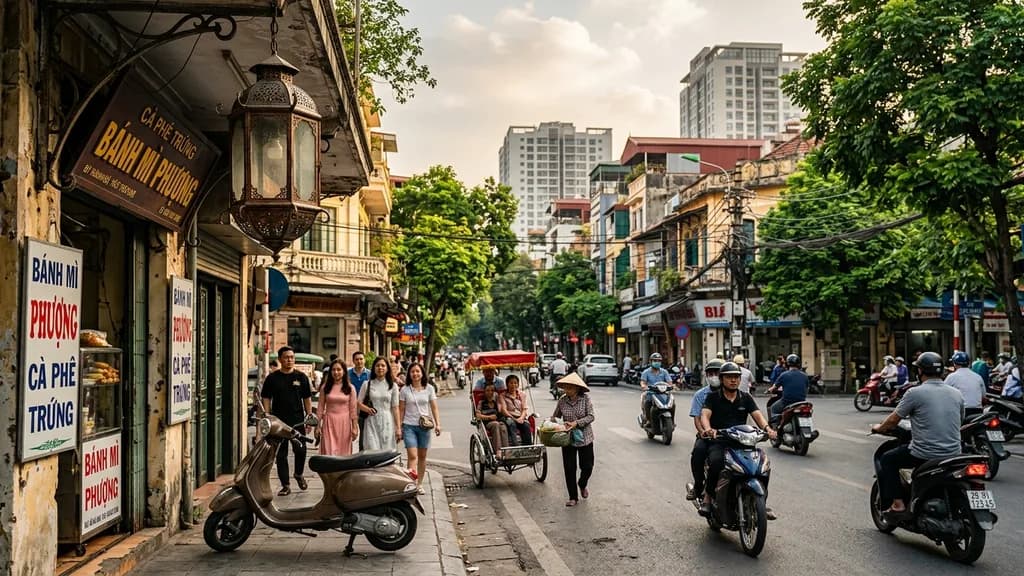
Hanoi vs Ho Chi Minh City: Honest 2026 Comparison
Vietnam has two capitals. One is official, the other is economic, and picking between them for your 2026 trip is the single biggest planning decision after "when do I go." Hanoi and Ho Chi Minh City (still called Saigon by almost everyone, including locals) are 1,760 km apart, and they feel that distance. Different weather, different food, different pace, different personality. This guide is the honest head-to-head: ten dimensions, four tables, zero fluff.
If you have two weeks, do both. Most people do. But if you are tight on time or trying to decide which city to base yourself in, this comparison will save you a lot of forum scrolling.
TL;DR: 10-Dimension Comparison
| Dimension | Hanoi | Ho Chi Minh City |
|---|---|---|
| Population | 8.5 million | 9.3 million |
| Founded | 1010 AD (1,015 years) | 1698 (as Prey Nokor, 327 years as Vietnamese city) |
| Vibe | Traditional, layered, slower | Modern, hustling, 24-hour |
| Weather | 4 seasons, cool Oct to Mar | Tropical, 25 to 35°C year-round |
| Signature food | Pho bac, bun cha, nem ran | Pho nam, banh mi Saigon, com tam |
| Architecture | French colonial + old temples | Skyscrapers + French colonial |
| Gateway to | Halong Bay, Sapa, Ninh Binh | Mekong Delta, Cu Chi, Phu Quoc |
| Nightlife | Quiet, intimate, early | Loud, late, rooftop-heavy |
| Cost level | 10 to 15% cheaper | Slight premium |
| Best for | History, culture, first-timers | Nightlife, food variety, business |
Short version: Hanoi is the soul, Saigon is the engine. Neither is objectively better. What changes is which one matches your trip.
Decision Matrix: Which City For Your Trip?
Pick the row that describes you, and the column tells you where to lean.
| Traveller type | Pick Hanoi | Pick HCMC |
|---|---|---|
| First-time Vietnam visitor | Yes | Secondary |
| History and colonial architecture | Primary | Secondary |
| Nightlife and rooftop bars | No | Primary |
| Food-focused (street food) | Slight edge | Great variety |
| Halong Bay or Sapa trip | Essential base | Wrong city |
| Mekong Delta or Phu Quoc trip | Wrong city | Essential base |
| Solo traveller looking for scene | Quieter | Livelier |
| Cool weather in winter | No, cold | Yes, tropical |
| Budget-conscious | 10 to 15% cheaper | Premium |
If you are reading this as your first Vietnam trip, read the first-time Vietnam guide alongside it. For a deeper north-south cultural comparison beyond just the cities, see north vs south Vietnam.
History: 1,000-Year Capital vs 300-Year Port
The most fundamental split between these cities is time depth, and it shows everywhere.
Hanoi: The Thousand-Year Capital
Hanoi was founded in 1010 AD when Emperor Ly Thai To moved the capital of Dai Viet to what he called Thang Long, "ascending dragon." That makes Hanoi older than Moscow, older than Berlin, older than the Tower of London. The Old Quarter's 36 streets, each named after the guild that once worked it (Hang Bac for silver, Hang Dao for silk), still function as commercial arteries almost unchanged in layout since the 13th century.
Then came 67 years as a French colonial capital (1887 to 1954), which is why you walk past pastel villas, tree-lined boulevards, the Opera House modeled on Palais Garnier, and pate-stuffed banh mi carts on the same block as Buddhist temples from the Ly dynasty. Hanoi is a layered city. You can literally point at a wall and see three centuries stacked on top of each other.
HCMC: The French Port That Became Saigon
Ho Chi Minh City's story is the opposite. It was a sleepy Khmer fishing village called Prey Nokor until the 1690s, when Vietnamese settlers pushed south. The French took it in 1859 and built "the Paris of the East" in 40 years flat, Notre Dame Cathedral (1880), Central Post Office (1891), Continental Hotel (1880), all of which you can still walk past today in District 1.
Then came the American war period, where Saigon was the capital of South Vietnam and the staging ground for a million US troops. That era's legacy is everything from the War Remnants Museum to the backpacker culture on Pham Ngu Lao and Bui Vien, originally built to entertain off-duty soldiers, now backpacker central. After reunification in 1975, the city was renamed Ho Chi Minh City, but the old name never died. If you call it Saigon, nobody will correct you.
The economic boom since 1986's doi moi reforms turned HCMC into Vietnam's commercial powerhouse. Skyscrapers like Landmark 81 (461 m, tallest in Vietnam) now tower over 19th-century colonial facades.
Weather: Four Seasons vs Eternal Summer
If you have flexibility on dates, weather should drive your decision more than anything else.
| Month | Hanoi | HCMC |
|---|---|---|
| Jan to Feb | 13 to 19°C, grey, drizzly | 22 to 32°C, dry, sunny |
| Mar to Apr | 18 to 26°C, warming, pleasant | 25 to 35°C, hot, dry |
| May to Jun | 25 to 33°C, hot, humid | 26 to 34°C, wet season starts |
| Jul to Aug | 26 to 34°C, peak humidity, storms | 25 to 33°C, afternoon rain daily |
| Sep to Oct | 22 to 29°C, dry, clear, best time | 25 to 33°C, wet season ends |
| Nov to Dec | 16 to 22°C, cool, clear | 23 to 32°C, dry, breezy |
Hanoi has four real seasons. January and February are genuinely cold, locals wear puffy jackets, and if you arrive in shorts you will be miserable. Summer (June to August) is hot and storm-prone. The sweet spots are October to November (cool, dry, golden) and March to April (warming, clear).
HCMC has two seasons: dry (December to April) and wet (May to November). Temperature barely moves (25 to 35°C all year). In wet season expect a dramatic one-hour downpour around 3 to 4 PM, then sunshine. Tourism runs year-round.
The practical takeaway: if you are visiting in December through February, go south, Hanoi is cold and grey. If you are visiting in October to November, Hanoi is spectacular and HCMC is still fine. March to May is the only window where both cities are pleasant at the same time.
Food Head-to-Head
Both cities eat world-class, but they eat very differently. If you only order one dish, order pho in both cities on the same trip and taste the regional split for yourself.
| Dish | Hanoi version (pho bac) | HCMC version (pho nam) |
|---|---|---|
| Pho broth | Clearer, leaner beef, less sugar | Sweeter, richer, heavier bones |
| Pho garnish | Scallion, chili, lime, that's it | Giant herb plate, bean sprouts, hoisin, sriracha |
| Banh mi | Smaller, meatier, less salad | Loaded with pate, pickled veg, herbs |
| Coffee | Ca phe trung (egg coffee) invented here | Ca phe sua da (iced milk coffee) dominant |
| Beer | Bia Hoi corner on tiny plastic stools | Craft beer scene, rooftop lagers |
| Signature dish | Bun cha (grilled pork + noodles) | Com tam (broken rice + grilled pork) |
Hanoi's Signature Plate
In Hanoi, eat bun cha (smoky grilled pork patties, cold noodles, fish sauce broth) at any time between 11 AM and 2 PM. Bun Cha Huong Lien became world famous when Obama and Anthony Bourdain ate there in 2016, but a hundred other spots do it just as well for 60,000 to 100,000 VND (2.40 to 4 USD). Also essential: nem ran (crispy fried spring rolls), ca phe trung (egg coffee, a wartime invention when milk was scarce, now iconic), and pho bac at 6 AM from Pho Gia Truyen on Bat Dan street. For a full route, see our Hanoi Old Quarter walking guide.
HCMC's Signature Plate
In HCMC, your non-negotiables are banh mi Saigon (the template for every banh mi on earth, best at Banh Mi Huynh Hoa for 68,000 VND / 2.70 USD), com tam (broken rice plate with grilled pork chop, sunny-side egg, and fish sauce, peak lunch food), and bun bo Hue (spicy central-Vietnamese noodle soup that thrives in Saigon thanks to wartime migration). Southern pho is a completely different dish, sweeter, with a mountain of herbs. Judge for yourself.
Verdict: Hanoi food is more distinctly regional and harder to find done right outside the city. HCMC food is more diverse and has higher peaks (one of Asia's best rooftop dining scenes exists here). Serious eaters should budget three meals a day in both.
Nightlife: The Clearest Difference
This one is not close. HCMC wins by a huge margin.
| Scene | Hanoi | HCMC |
|---|---|---|
| Rooftop bars | A handful, mostly in Old Quarter | 30+ across District 1 and 2 |
| Backpacker strip | Ta Hien (beer corner) | Bui Vien walking street |
| Late night (after 1 AM) | Mostly closed | Just getting started |
| Club scene | Small, local | International, packed |
| Craft beer | Growing, ~15 breweries | Mature, 40+ craft bars |
Hanoi nightlife is about sitting on a 20 cm plastic stool on Ta Hien corner with a 10,000 VND (0.40 USD) glass of bia hoi (fresh beer), watching the Old Quarter swirl past. The atmosphere is warm and local. Rooftop spots like Skyline Hanoi and Summit Lounge at Pan Pacific exist, but the city genuinely goes to bed around 11 PM. Wednesday and Saturday are the only nights the street-beer corners really buzz.
HCMC nightlife is a different category. Rooftop bars like Chill Skybar (26th floor), Shri (23rd floor), and EON Heli Bar (52nd floor of Bitexco) serve cocktails at altitude with Saigon spread out below. Bui Vien is the loud backpacker street with 200+ bars and clubs in a 4-block grid. District 2 (Thao Dien) has the expat craft beer scene, Pasteur Street Brewing, Heart of Darkness, East West Brewing. Clubs run until 3 or 4 AM on Friday and Saturday.
If nightlife is central to your trip, base in HCMC. If quiet nights with a book and a coffee are your pace, Hanoi.
Gateway Access: What Each City Unlocks
This is where the choice gets strategic. Each city is a doorway to a completely different piece of Vietnam.
Hanoi as a Base
- Halong Bay (2.5 to 3 hours by road): iconic UNESCO limestone karst seascape. Day trips exist but overnight cruises (1,500,000 to 5,000,000 VND / 60 to 200 USD per person) are the real experience.
- Sapa (6 hours by overnight train or 5.5 hours by expressway): rice terraces, ethnic minority villages, trekking through H'mong and Dao hamlets.
- Ninh Binh (1.5 hours): limestone karsts on land, boat rides through flooded caves (Trang An, Tam Coc), ancient temples.
- Ha Giang loop (6 hours north): motorbike adventure on the most dramatic road in Southeast Asia.
- Mai Chau / Pu Luong (3 to 4 hours): rural valleys, homestays, less touristed.
HCMC as a Base
- Mekong Delta (2 to 3 hours): floating markets, coconut-candy villages, homestays in the nine-dragons river region.
- Cu Chi Tunnels (1.5 hours): Viet Cong tunnel network from the American war, crawlable sections, rifle ranges.
- Phu Quoc (1 hour flight): beach island with resorts, snorkeling, cable car to Hon Thom.
- Con Dao Islands (45 min flight): ex-prison island turned protected marine park, best beaches in Vietnam.
- Vung Tau (2 hours by hydrofoil or road): nearest real beach, weekend escape for locals.
- Mui Ne / Phan Thiet (4 hours): sand dunes, kitesurfing, fresh seafood.
Notice that the lists do not overlap at all. This is why most two-week itineraries include both cities. See our Vietnam 2-week itinerary for how to string it together.
Getting Between Them
You have three real options to travel the 1,760 km between Hanoi and HCMC.
| Option | Duration | Price (VND / USD) | Best for |
|---|---|---|---|
| Flight (Vietjet, Bamboo, VN Airlines) | 2h10 | 750,000 to 2,000,000 / 30 to 80 | Almost everyone |
| Reunification Express train | 30 to 35h | 900,000 to 2,000,000 / 36 to 80 (soft sleeper) | Slow travellers, scenery |
| Open bus (multiple stops) | 40 to 50h | 1,200,000 to 1,800,000 / 48 to 72 | Budget + want to stop in Hue/Hoi An |
Fly unless you have a reason not to. VietJet runs 5 to 6 daily flights from 750,000 VND (30 USD) if booked a week out, Bamboo and Vietnam Airlines are slightly more expensive but include checked baggage. Hanoi (HAN) and Saigon (SGN) airports are both 45 minutes to the city center by Grab (taxi-app).
Reunification Express is the romantic option. Two days rolling south along the coast, past Hue, Danang, Nha Trang. Soft-sleeper cabin for four is the sweet spot. You will see rice paddies, fishing villages, mountain passes, and sunsets from your bunk. Read our full Reunification Express journey guide.
Open bus is only worth it if you are stopping at Hue, Hoi An, Nha Trang, and Dalat en route. Otherwise the time cost outweighs the savings.
Hotels and Costs
Prices for the same category are roughly 10 to 15% higher in HCMC. Quality is comparable.
| Category | Hanoi (VND / USD per night) | HCMC (VND / USD per night) |
|---|---|---|
| Hostel dorm | 150,000 to 300,000 / 6 to 12 | 180,000 to 350,000 / 7 to 14 |
| Budget hotel | 400,000 to 700,000 / 16 to 28 | 500,000 to 800,000 / 20 to 32 |
| Mid-range 3-star | 700,000 to 1,400,000 / 28 to 56 | 800,000 to 1,600,000 / 32 to 64 |
| 4-star boutique | 1,500,000 to 3,000,000 / 60 to 120 | 1,700,000 to 3,500,000 / 68 to 140 |
| Luxury 5-star | 4,000,000+ / 160+ | 5,000,000+ / 200+ |
In Hanoi, base yourself in the Old Quarter for the first-time experience or around West Lake (Tay Ho) for a quieter expat-feel neighbourhood. In HCMC, District 1 puts you near the sights, District 3 is slightly calmer with a food edge, and District 2 (Thao Dien) is the leafy expat zone. Compare rates on Booking.com for both cities side by side before deciding. If you are weighing hostels against guesthouses, our budget hostels vs guesthouses breakdown helps.
For food costs, street meals run 30,000 to 80,000 VND (1.20 to 3.20 USD) per plate in both cities. Mid-range restaurants 200,000 to 500,000 VND (8 to 20 USD) for two. Beer 20,000 VND (0.80 USD) at a bia hoi corner, 60,000 to 120,000 VND (2.40 to 4.80 USD) at a normal bar.
Safety
Both cities are among the safest capitals in Southeast Asia for tourists. Violent crime against foreigners is vanishingly rare. What you actually need to watch:
- Phone snatching by motorbike, more common in HCMC (District 1, Bui Vien, Nguyen Hue walking street). Do not hold your phone at the edge of the pavement.
- Taxi meter tampering, use Grab or XanhSM (electric) app in both cities rather than flagging down. Mai Linh and Vinasun are the legitimate traditional taxis if you must flag.
- Scooter theft of bags, wear your daypack on your front or cross-body when walking.
- Overcharging at airport taxis, always use the Grab queue or pre-book.
- Crossing the street, walk at a steady pace, do not stop, do not run. Scooters flow around you like water.
Hanoi feels slightly calmer. HCMC feels busier and has the slight petty-theft edge. Neither should worry you.
The Daily Rhythm
This is one of the most underrated differences. The cities open and close at different times.
Hanoi is an early city. Markets buzz at 5 AM. Pho stalls open at 6 AM. Office workers break for lunch at 11:30 and nap. Dinner is early, 6 to 7:30 PM. Most restaurants are closed by 10, bars by 11, and the Old Quarter is quiet by midnight except on Ta Hien corner.
HCMC is a late city. Street food stalls run until 2 AM. Rooftop bars are at peak 10 PM to 1 AM. Clubs open at midnight. Offices open later (8:30 or 9 AM) and dinner is often 8 PM. Traffic peaks twice, 7 to 9 AM and 5 to 8 PM, and the weather pushes more activity to evening.
Match your internal clock to the city. Early risers thrive in Hanoi. Night owls thrive in Saigon.
Both in One Trip: The Standard Route
For most travellers, the answer is not "either / or" but "both, in this order." Fly into Hanoi, work your way south, fly out of HCMC.
10-day version: Hanoi 3 nights, Halong Bay 1 night, Hoi An 3 nights, HCMC 2 nights. Free things to do in HCMC helps stretch the budget on the tail end.
14-day version: Hanoi 3, Halong 1, Sapa 2, Hoi An 3, Hue 1, HCMC 2, Mekong 1, Phu Quoc 2. Full breakdown in Vietnam 2-week itinerary.
Why north-to-south? Weather adjusts you gradually to heat. Flights out of SGN to Bangkok, Singapore, Kuala Lumpur, and Hong Kong are cheaper and more frequent than out of HAN. And after the slower pace of Hanoi, the electric buzz of Saigon feels like a farewell party rather than a culture shock.
If you are booking tours in either city, browse GetYourGuide for skip-the-line options on Cu Chi Tunnels, Halong cruises, and Mekong day trips, these are the tours where pre-booking actually saves time.
The Honest Verdict
After all of this, here is the call.
Pick Hanoi if: you want traditional Vietnamese atmosphere, you are visiting October through April, Halong Bay or Sapa are on your list, you prefer slower mornings and quieter nights, or this is your first time in Vietnam and you want the iconic experience.
Pick HCMC if: you want a modern Asian metropolis, you are visiting May through September, the Mekong Delta or Phu Quoc beaches are on your list, nightlife and rooftop bars matter to you, or you are combining Vietnam with Cambodia or Thailand (HCMC is the better hub).
Pick both if: you have 10+ days. You should. This is the default plan and it works.
Neither city is better. They are complements, not competitors, and Vietnam reveals itself fully only when you have stood on both the Hoan Kiem Lake bridge at dawn and a Saigon rooftop at midnight in the same trip.
Related reads:
Sources & References
This article is based on first-hand experience and verified with the following official sources:

Exploring Vietnam since 2020 | 40+ provinces visited | Updated monthly
We are a team of travel writers and Vietnam enthusiasts who explore the country year-round. Our guides are based on first-hand experience, local knowledge, and verified official sources.
More about us →People Also Read

Vietnam E-Visa 2026: How to Apply, Costs & Processing Time
Complete guide to Vietnam e-visa in 2026: step-by-step application, exact costs, processing times, and common mistakes to avoid.

Vietnam E-Visa 2026: How to Apply, Costs & Processing Time
Complete guide to Vietnam e-visa 2026: step-by-step application, exact costs, processing times, and eligibility. Apply online in minutes.
Vietnam E-Visa 2026: How to Apply, Costs & Processing Time
Complete guide to Vietnam E-Visa 2026: step-by-step application process, exact costs, processing times, and everything you need to know before traveling.
Vietnam E-Visa 2026: Complete Guide to Application, Costs & Processing Time
Step-by-step Vietnam e-visa guide for 2026: application process, exact costs, processing times, and answers to common questions.
Plan Your Vietnam Trip
Book hotels, transport, activities, and get connected with an eSIM
Some links are affiliate links. We may earn a commission at no extra cost to you.