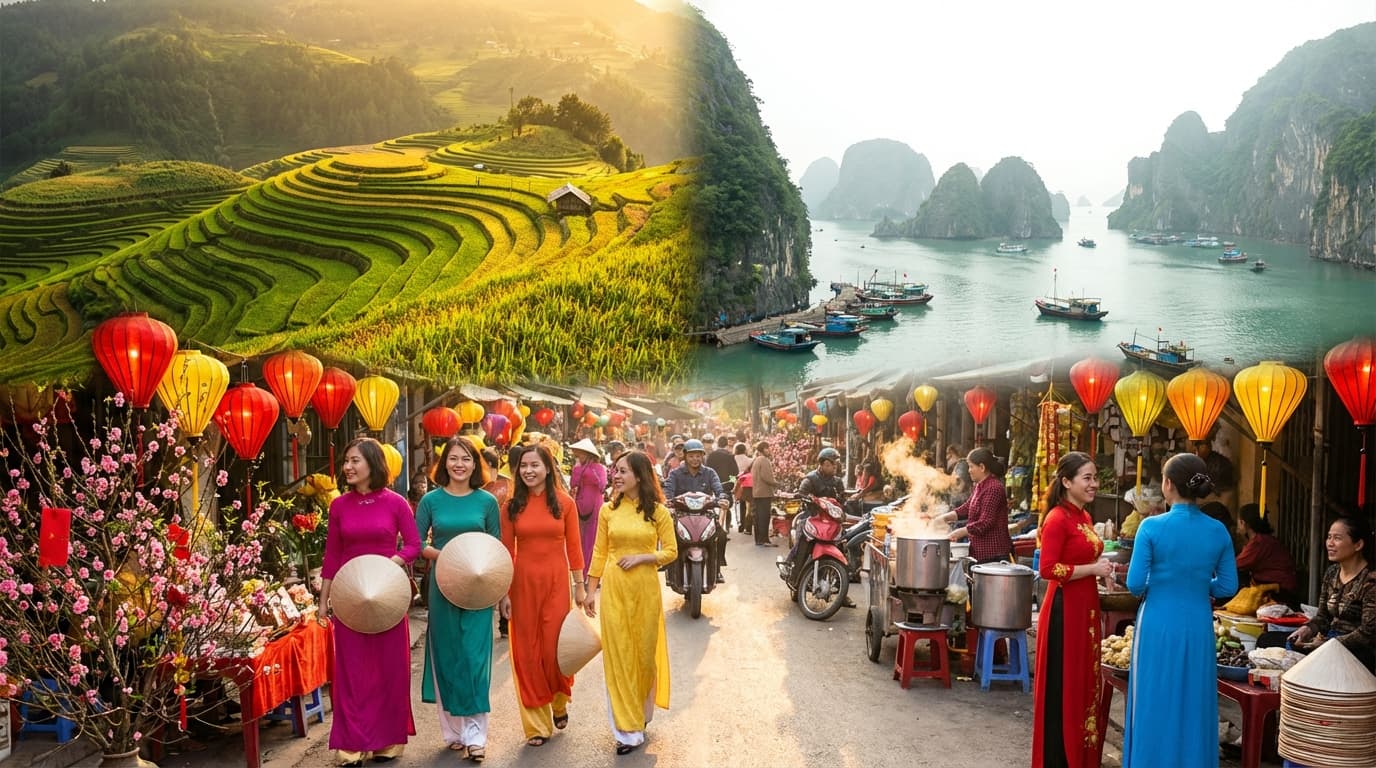
Imagine standing on a beach in Vietnam during the dry season—the sky is crystalline blue, the air is crisp, and you can actually see the limestone cliffs of Ha Long Bay rising from perfectly clear water. Now picture the same beach during the wet season: monsoon rains pummel the coast, visibility drops to meters, and most tourists have fled. The difference between Vietnam's seasons isn't just weather—it's the difference between an unforgettable trip and a frustrating one.
After two years living in Hanoi and extensive travel throughout the country, we've learned that timing your Vietnam visit around the dry season versus wet season is the single most important decision you'll make. This guide breaks down exactly what you need to know, month by month, to plan the perfect trip.
Key Takeaways
| Question | Answer |
|---|---|
| What is the best time to visit? | November to April (dry season) for most of Vietnam, though regional variations exist. October and May are shoulder months with fewer crowds. |
| How much does it cost? | Peak season (Dec-Feb): $50-150/night hotels; Shoulder season (Oct-Nov, Mar-Apr): $30-80/night; Wet season: $20-50/night |
| How do I get there? | Fly into Hanoi, Ho Chi Minh City, or Da Nang; use buses or trains for regional travel |
| Is it safe? | Vietnam is safe year-round; typhoons (Sept-Nov) and flooding (May-Sept in central regions) are weather concerns, not safety issues |
| What should I book in advance? | Hotels and flights during Dec-Feb; tours to Ha Long and Sapa during peak season; domestic flights anytime |
| What's the humidity like? | Dry season: 60-75% humidity; Wet season: 75-95% humidity with frequent rainfall |
| Can I visit during wet season? | Yes—fewer tourists, lower prices, lush landscapes, but expect rain, humidity, and some activity cancellations |
1. Understanding Vietnam's Two Main Seasons
Vietnam's climate is dominated by two monsoon systems that create distinctly different travel experiences across the country. The dry season (generally November to April) brings cool, clear weather to most of Vietnam, while the wet season (May to October) brings heavy rainfall, high humidity, and occasional typhoons.
However—and this is crucial—Vietnam is a long, narrow country stretching over 1,600 kilometers from north to south. The weather patterns differ dramatically by region. What's dry in the north might be wet in the south, and vice versa. During our time exploring from Hanoi to the Mekong Delta, we discovered that the "best time to visit" depends entirely on which region you're targeting.
The Dry Season Advantage
The dry season is peak tourist season for good reason. Clear skies mean better visibility for activities like Ha Long Bay cruises, hiking in Sapa, and island hopping. Temperatures are comfortable—ranging from 15°C in the north to 28°C in the south. Rain is minimal, humidity is lower, and outdoor activities rarely get cancelled.
The Wet Season Reality
The wet season isn't a travel disaster—it's just different. Prices drop by 30-50%, crowds disappear, and the countryside turns lush and green. However, daily downpours are common (especially afternoons), some mountain roads become treacherous, and a few activities like boat tours may be cancelled due to rough seas or poor visibility. In our experience, the wet season suits flexible travelers who don't mind rain and want authentic, less-touristy experiences.
2. Northern Vietnam: Hanoi, Sapa, and Ha Long Bay (November to April)
North Vietnam experiences the most dramatic seasonal shift. Winter (November to February) brings cool, dry weather—a stark contrast to the hot, humid summers. If you're planning to visit Hanoi, Sapa, or Ha Long Bay, the dry season is essential.
During our two years in Hanoi, we watched the city transform in November. Suddenly, the oppressive heat lifted, the air cleared, and locals emerged onto the streets in the evenings. This is when you should visit the north. December through February sees temperatures drop to 10-15°C in Sapa and 12-20°C in Hanoi—cool enough to require a light jacket, but perfect for walking and exploring.
November to February: Peak Season in the North
This is the golden window for northern Vietnam. Hanoi's Old Quarter is walkable without melting into the pavement. Ha Long Bay offers stunning visibility for limestone karst photography. Sapa's terraced rice fields are emerald green, and hiking trails are dry and safe. Hotels fill up quickly, especially in December and January, and prices reflect the demand.
Peak Season Details:
- Temperature: Hanoi 12-20°C, Sapa 8-15°C, Ha Long 12-18°C
- Rainfall: Minimal (under 50mm per month)
- Crowds: Very high, especially Dec-Jan
- Hotel prices: $60-150/night for mid-range options
- Best activities: Ha Long Bay cruises, Sapa trekking, Hanoi street food tours, cave exploration
March to April: Shoulder Season (Underrated)
March and April are often overlooked, but they're exceptional months in the north. The weather remains dry and clear, temperatures warm up to 20-28°C, and crowds thin significantly after the Chinese New Year rush. We've found that March offers the best balance of good weather and manageable tourism.
Compare hotels, resorts, and guesthouses across Vietnam with free cancellation on most bookings.
Search Hotels on Booking.com → Scan me
Shoulder Season Advantages:
- Fewer crowds than peak season
- Lower prices (20-30% cheaper than Dec-Feb)
- Still excellent weather for all outdoor activities
- Longer daylight as spring progresses
- Local festivals like Ha Noi Spring Festival (late Feb-early March)
3. Central Vietnam: Hoi An, Hue, and Da Nang (October to April)
Central Vietnam has a slightly different seasonal pattern than the north. The region experiences both the northeast monsoon (bringing dry conditions) and occasional typhoons from the southwest. The sweet spot for central Vietnam is October through April, though October and November can still see tropical storms.
When we explored Hoi An and Hue, we learned that this region's weather is more unpredictable than the north. September and October bring typhoons and heavy rain. By November, conditions stabilize, and the region enjoys clear, warm weather through April.
October to April: Dry Season in Central Vietnam
Compare hotels, resorts, and guesthouses across Vietnam with free cancellation on most bookings.
Search Hotels on Booking.com →
Scan me
This is the optimal window for the central coast. Temperatures range from 20-28°C, humidity drops to comfortable levels, and rainfall is minimal. The beaches around Da Nang and Nha Trang are perfect for swimming. The ancient towns of Hoi An and Hue are pleasant for walking and exploring.
Central Vietnam Dry Season:
- Temperature: 20-28°C
- Rainfall: Minimal (under 100mm per month)
- Best months: November-March (most stable)
- Avoid: September-October (typhoon season)
- Hotel prices: $40-120/night for mid-range
- Best activities: Beach time, island hopping to Cham Islands, ancient town exploration, cooking classes
May to September: Wet Season (Hot and Humid)
The wet season in central Vietnam is characterized by afternoon downpours and high humidity (80-90%). However, mornings are often clear, and prices drop significantly. If you visit during this period, plan water-based activities for the morning and indoor experiences (cooking classes, museums, local markets) for afternoons when rain is most likely.
Did You Know? Central Vietnam experiences the highest rainfall in September and October, with some areas receiving over 300mm of rain per month during typhoon season.
4. Southern Vietnam: Ho Chi Minh City, Phu Quoc, and the Mekong Delta (November to April)
South Vietnam has the most straightforward seasonal pattern. The dry season runs from November to April, with December through February being the absolute best months. The wet season (May to October) is hot, humid, and rainy—but it's also when the Mekong Delta is at its most vibrant.
During our time in Ho Chi Minh City, we experienced both seasons. The dry season is when locals actually venture outdoors; the wet season is when the city feels like a sauna, and you're either in an air-conditioned café or caught in a sudden downpour.
November to April: Peak Season in the South
This is unquestionably the best time to visit southern Vietnam. Temperatures are warm but not oppressive (25-32°C), humidity is lower (60-75%), and rainfall is minimal. Ho Chi Minh City is walkable, Phu Quoc beaches are pristine, and the Mekong Delta is accessible via boat tours.
Southern Dry Season Breakdown:
| Month | Temperature | Rainfall | Crowds | Price Level |
|---|---|---|---|---|
| November | 26-32°C | Minimal | Medium | $$ |
| December | 25-31°C | Minimal | Very High | $$$ |
| January | 25-30°C | Minimal | Very High | $$$ |
| February | 26-31°C | Minimal | High | $$$ |
| March | 27-33°C | Low | Medium | $$ |
| April | 28-35°C | Low | Low | $ |
May to October: Wet Season (Monsoon Rains)
The wet season in the south is characterized by afternoon thunderstorms, high humidity (80-95%), and temperatures hovering around 28-35°C. However, mornings are often clear, and the landscape is lush and green. The Mekong Delta is particularly beautiful during this period, with water levels high and rice paddies flooded.
Wet Season Advantages:
- Prices drop 40-60% compared to peak season
- Fewer tourists means authentic local experiences
- Mekong Delta is lush and water levels are high
- Fewer crowds at major attractions like Phu Quoc
Skip the hassle — book Vietnam day trips, cooking classes, and experiences in advance with instant confirmation.
Browse Activities on Klook → Scan me
5. Month-by-Month Breakdown: What to Expect and Where to Go
January: Peak Season Everywhere
January is the busiest month across all of Vietnam. The weather is excellent in the north and south, Christmas holidays are over, and Chinese New Year approaches. Hotels are fully booked, prices are at their highest, and popular sites like Ha Long Bay have queues. If you must visit in January, book everything in advance and expect crowds.
Best for: Peak season travelers who don't mind crowds; those with fixed holiday dates Avoid: Budget travelers; those seeking solitude
February: Chinese New Year (Tet)
February brings Tet (Lunar New Year), Vietnam's most important holiday. The country shuts down for a week, many businesses close, and locals travel to hometowns. If you're in Vietnam during Tet, expect closed restaurants, limited transportation, and festive but chaotic streets. However, if you time it right, you'll witness incredible cultural celebrations.
Best for: Cultural immersion; witnessing Tet festivities Avoid: Those needing reliable services; those seeking quiet experiences
March: Ideal Shoulder Season
March is our favorite month to visit Vietnam. The weather is excellent across the country, crowds have thinned after Tet, and prices are 20-30% lower than peak season. The north is warm but not hot, the south is warm and dry, and central Vietnam is perfect.
Best for: All regions; all activity types Avoid: Nothing—March is excellent
April: Heating Up (But Still Good)
April marks the transition to summer. Temperatures rise, especially in the south (reaching 35°C+), but the weather remains dry. Crowds are minimal, and prices are at their lowest for the dry season. If you can handle heat, April offers great value.
Best for: Budget travelers; those who don't mind heat Avoid: Heat-sensitive travelers
May to September: Wet Season
May through September is the wet season across most of Vietnam. Expect afternoon downpours, high humidity, and occasional typhoons (especially in central Vietnam). However, prices are lowest, crowds disappear, and the landscape is lush. This is ideal for flexible travelers, budget backpackers, and those seeking authentic, less-touristy experiences.
Best for: Budget travelers; flexible itineraries; those seeking green landscapes Avoid: Those requiring guaranteed outdoor activities; those sensitive to humidity
October: Transition Month (Risky)
October is a transition month—the wet season is ending, but typhoons are still possible, especially in central Vietnam. The north begins to cool, and the south remains hot and humid. Weather is unpredictable, but prices are dropping and crowds are thinning.
Best for: Flexible travelers; those comfortable with weather uncertainty Avoid: Those with fixed activity plans
November: Dry Season Begins
November marks the start of the dry season. The north begins to cool noticeably, the south remains warm and dry, and central Vietnam stabilizes. This is an excellent month—good weather, reasonable crowds, and prices between shoulder and peak season.
Best for: All regions; those seeking balance between weather and crowds Avoid: Nothing—November is excellent
December: Peak Season Begins
December brings peak season weather and peak season crowds. The north is cool and dry, the south is warm and dry, and central Vietnam is perfect. However, Christmas holidays bring tourists, prices spike, and popular sites are crowded.
Best for: Those with fixed holiday dates; those prioritizing weather over crowds Avoid: Budget travelers; those seeking solitude
6. Regional Weather Patterns: A Detailed Comparison
Understanding regional differences is crucial for planning your route. Vietnam's geography means that while the north is cool and dry, the south might be hot and humid—or vice versa during shoulder seasons.
North Vietnam Weather Pattern
Skip the hassle — book Vietnam day trips, cooking classes, and experiences in advance with instant confirmation.
Browse Activities on Klook →
Scan me
The north experiences a true winter (November to February) with temperatures dropping to 10-15°C in highland areas like Sapa. This is the only region where you'll need a jacket. The dry season is November to April, with the wettest months being May to September.
North Vietnam Summary:
- Dry season: November-April
- Best months: December-February (cool and dry)
- Shoulder months: March-April (warm and dry)
- Wet season: May-October
- Typhoon risk: Low (typhoons typically affect central/southern coasts)
Central Vietnam Weather Pattern
Central Vietnam is the most unpredictable region. The northeast monsoon (October to April) brings dry conditions, but the southwest monsoon (May to September) brings heavy rain and occasional typhoons. September and October are particularly risky for typhoons.
Central Vietnam Summary:
- Dry season: October-April (but October is risky)
- Best months: November-March (most stable)
- Shoulder months: April-May (warming up)
- Wet season: May-September
- Typhoon season: September-October (high risk)
South Vietnam Weather Pattern
The south has the simplest pattern: dry from November to April, wet from May to October. There's no winter—temperatures remain warm year-round. The dry season is peak season; the wet season is low season but still visitable.
South Vietnam Summary:
- Dry season: November-April
- Best months: December-February (warmest and driest)
- Shoulder months: March-April (warm, fewer crowds)
- Wet season: May-October
- Typhoon risk: Low (typhoons typically affect central coast)
7. Festivals and Events: Planning Around Cultural Celebrations
Vietnam's calendar is packed with festivals, many tied to the lunar calendar and therefore changing dates each year. Visiting during a festival can be magical—or chaotic, depending on your preferences.
Major Festivals by Season
Tet (Lunar New Year) - January/February Vietnam's most important holiday. The country shuts down for a week, but streets are decorated, families celebrate, and fireworks light up the sky. Many tourists and restaurants close, making it challenging for visitors. However, if you embrace the chaos, it's culturally unforgettable.
Hoi An Lantern Festival - Monthly (14th lunar month) Held monthly in Hoi An, this festival transforms the ancient town with thousands of lanterns. The town closes to traffic, and locals and tourists gather to release lanterns into the river. It's magical but crowded.
Hung Kings' Temple Festival - April (8th lunar month) A major festival honoring Vietnam's legendary founders, held primarily in northern Vietnam. It's less touristy than Tet but deeply meaningful to locals.
Mid-Autumn Festival - September/October (15th lunar month) Celebrated with lanterns, mooncakes, and children's processions. It's less chaotic than Tet but still festive.
Did You Know? Vietnam's Tet holiday is so important that the entire country essentially shuts down for a week. Many restaurants, shops, and services close, and domestic transportation is packed with locals traveling home.
Source: VnExpress International
Discover the best guided tours and activities in Hanoi, Ho Chi Minh City, Da Nang and beyond.
Browse Tours on GetYourGuide → Scan me
8. Practical Booking Tips: When to Reserve and What to Expect
Peak Season Booking (December to February)
During peak season, book everything 2-4 weeks in advance. Hotels fill up quickly, especially mid-range and budget options. Flights between major cities should be booked at least 1-2 weeks ahead. Popular tours (Ha Long Bay, Sapa trekking) can sell out, especially on weekends.
Peak Season Strategy:
- Book flights: 3-4 weeks in advance
- Book hotels: 2-3 weeks in advance
- Book tours: 1-2 weeks in advance (or book through your hotel)
- Expect prices: 30-50% higher than shoulder season
- Expect crowds: Very high at major attractions
Shoulder Season Booking (March to April, October to November)
Shoulder seasons offer the best balance of weather, crowds, and prices. You can usually book hotels 1-2 weeks in advance without issues. Flights are easier to find, and prices are 20-40% lower than peak season.
Shoulder Season Strategy:
- Book flights: 1-2 weeks in advance
- Book hotels: 1 week in advance
- Book tours: A few days in advance (usually available)
- Expect prices: 20-40% lower than peak season
- Expect crowds: Moderate; manageable at major sites
Wet Season Booking (May to September)
The wet season offers the lowest prices and smallest crowds. You can often book hotels just days in advance. However, some activities may be cancelled due to weather, so flexibility is essential.
Wet Season Strategy:
- Book flights: A few days to 1 week in advance
- Book hotels: Can often book same-day or next-day
- Book tours: Check weather forecasts; some tours may be cancelled
- Expect prices: 40-60% lower than peak season
- Expect crowds: Minimal; authentic local experiences
Book buses, trains, ferries, and transfers between Vietnamese cities easily online. Compare routes and prices.
Book Transport on 12Go → Scan me
9. Packing for Each Season: What to Bring
Dry Season Packing (November to April)
For the North (cool):
- Light jacket or sweater (especially for Sapa)
- Long pants
- Comfortable walking shoes
- Sunscreen and hat
- Light layers (mornings can be cool, afternoons warm)
For the South (warm):
- Lightweight, breathable clothing
- Shorts and t-shirts
- Sunscreen and hat
- Sunglasses
- Light rain jacket (occasional showers possible)
Wet Season Packing (May to September)
Compare car rental prices across Vietnam. Pick up at airports or city locations with flexible cancellation.
Compare Car Rentals →
Scan me
- Lightweight, quick-dry clothing
- Waterproof bag or dry bag
- Quality rain jacket or poncho
- Waterproof phone case
- Extra socks (wet feet are common)
- Umbrella (compact, travel-sized)
- Moisture-wicking fabrics (humidity is high)
Year-Round Essentials
- Comfortable walking shoes (you'll do a lot of walking)
- Sunscreen (sun is intense year-round)
- Insect repellent (mosquitoes year-round, dengue risk in wet season)
- Medications (bring from home; availability varies)
- Universal power adapter (Vietnam uses 220V, Type A/C plugs)
Get a Vietnam eSIM before you land. No physical SIM needed — activate instantly on your phone.
Get Saily eSIM for Vietnam → Scan me
10. Making Your Decision: A Regional Comparison Table
Use this table to quickly determine the best time for your specific itinerary:
| Region | Best Months | Temperature | Rainfall | Crowds | Price |
|---|---|---|---|---|---|
| North (Hanoi, Sapa, Ha Long) | Dec-Feb | 10-20°C | Minimal | Very High | $$$ |
| North (Hanoi, Sapa, Ha Long) | Mar-Apr | 15-28°C | Low | Medium | $$ |
| Central (Hoi An, Hue, Da Nang) | Nov-Mar | 20-28°C | Minimal | High | $$ |
| Central (Hoi An, Hue, Da Nang) | Apr-May | 25-32°C | Low | Low | $ |
| South (HCMC, Phu Quoc, Mekong) | Dec-Feb | 25-31°C | Minimal | Very High | $$$ |
| South (HCMC, Phu Quoc, Mekong) | Mar-Apr | 27-35°C | Low | Low | $ |
| All Regions | May-Oct | 28-35°C | High | Very Low | $ |
Frequently Asked Questions
What's the absolute best time to visit Vietnam?
November through March offers the best overall weather across all regions. March is our top pick—excellent weather, fewer crowds than December-February, and 20-30% lower prices. However, the "best" time depends on your priorities: peak season weather (Dec-Feb), shoulder season balance (Mar-Apr, Oct-Nov), or budget travel (May-Sept).
Can I visit Vietnam during the wet season?
Absolutely. The wet season (May-September) brings afternoon downpours, high humidity, and occasional typhoons, but it's still visitable. Prices are 40-60% lower, crowds are minimal, and the landscape is lush. Plan indoor activities for afternoons when rain is most likely, and avoid central Vietnam in September-October due to typhoon risk.
Is it safe to visit during typhoon season?
Typhoons primarily affect central Vietnam (September-October). The north and south are relatively safe. However, if a typhoon warning is issued, flights may be cancelled and activities suspended. Travel insurance is essential during this period. Check weather forecasts before booking and choose flexible accommodation policies.
How far in advance should I book?
Peak season (Dec-Feb): 3-4 weeks for flights, 2-3 weeks for hotels Shoulder season (Mar-Apr, Oct-Nov): 1-2 weeks for flights, 1 week for hotels Wet season (May-Sept): A few days to 1 week in advance
What's the humidity like, and will it bother me?
Dry season humidity: 60-75% (comfortable) Wet season humidity: 75-95% (very humid, can feel oppressive)
If you're humidity-sensitive, visit November-April. If you're flexible, the wet season is manageable with proper clothing and frequent breaks in air-conditioned spaces.
Should I visit multiple regions in one trip?
Yes, Vietnam's excellent transport infrastructure makes multi-region trips feasible. However, consider regional weather patterns. For example, visiting the north in February and the south in May isn't ideal (the south will be hot and wet). Instead, plan north-to-south trips during the dry season (Nov-Apr) or focus on one region if visiting during the wet season.
Conclusion
Vietnam's dry season versus wet season fundamentally shapes your travel experience. The dry season (November to April) offers excellent weather, clear skies, and vibrant tourism infrastructure—but expect crowds and higher prices. The wet season (May to September) brings lower costs, fewer tourists, and lush landscapes—but requires flexibility and tolerance for rain and humidity.
Our recommendation? Visit during the shoulder seasons (March-April or October-November) for the best balance of weather, crowds, and prices. If you must visit during peak season, book in advance and embrace the energy. If budget is your priority, the wet season offers incredible value for flexible travelers.
For detailed information on specific destinations, check out our guides to Hanoi, Ho Chi Minh City, Da Nang, and other major cities. And don't forget to arrange your travel insurance before you go—it's essential for peace of mind.
Ready to plan your Vietnam adventure? Start by deciding which regions interest you most, then use this guide to choose your ideal travel dates. Vietnam is waiting.
Go2Vietnam Team — Sharing 2+ years of on-the-ground Vietnam experience to help you travel smarter.
Sources & References
This article is based on first-hand experience and verified with the following official sources:

Go2Vietnam Team
Exploring Vietnam since 2020 | 40+ provinces visited | Updated monthly
We are a team of travel writers and Vietnam enthusiasts who explore the country year-round. Our guides are based on first-hand experience, local knowledge, and verified official sources.
More about us →People Also Read

Vietnam's Typhoon Season: What Travelers Need to Know
Complete guide to Vietnam's typhoon season: timing, affected regions, safety tips, and best alternatives. Plan smarter.

Best Vietnamese Destinations to Visit During Rainy Season
Discover the best Vietnamese destinations to visit during rainy season. Lower prices, fewer crowds, and lush landscapes await.

Vietnam in 2 Weeks: The Perfect North-to-South Itinerary
The ultimate 14-day Vietnam itinerary from Hanoi to Ho Chi Minh City. Day-by-day breakdown with transport options, costs in VND and USD, and honest advice on what to skip.
Free Things to Do in Ho Chi Minh City: Budget Travel Guide 2025
Explore Ho Chi Minh City without breaking the bank. Free attractions, budget eats, and insider tips for travelers on a tight budget.
Plan Your Vietnam Trip
Book hotels, transport, activities, and get connected with an eSIM
Some links are affiliate links. We may earn a commission at no extra cost to you.