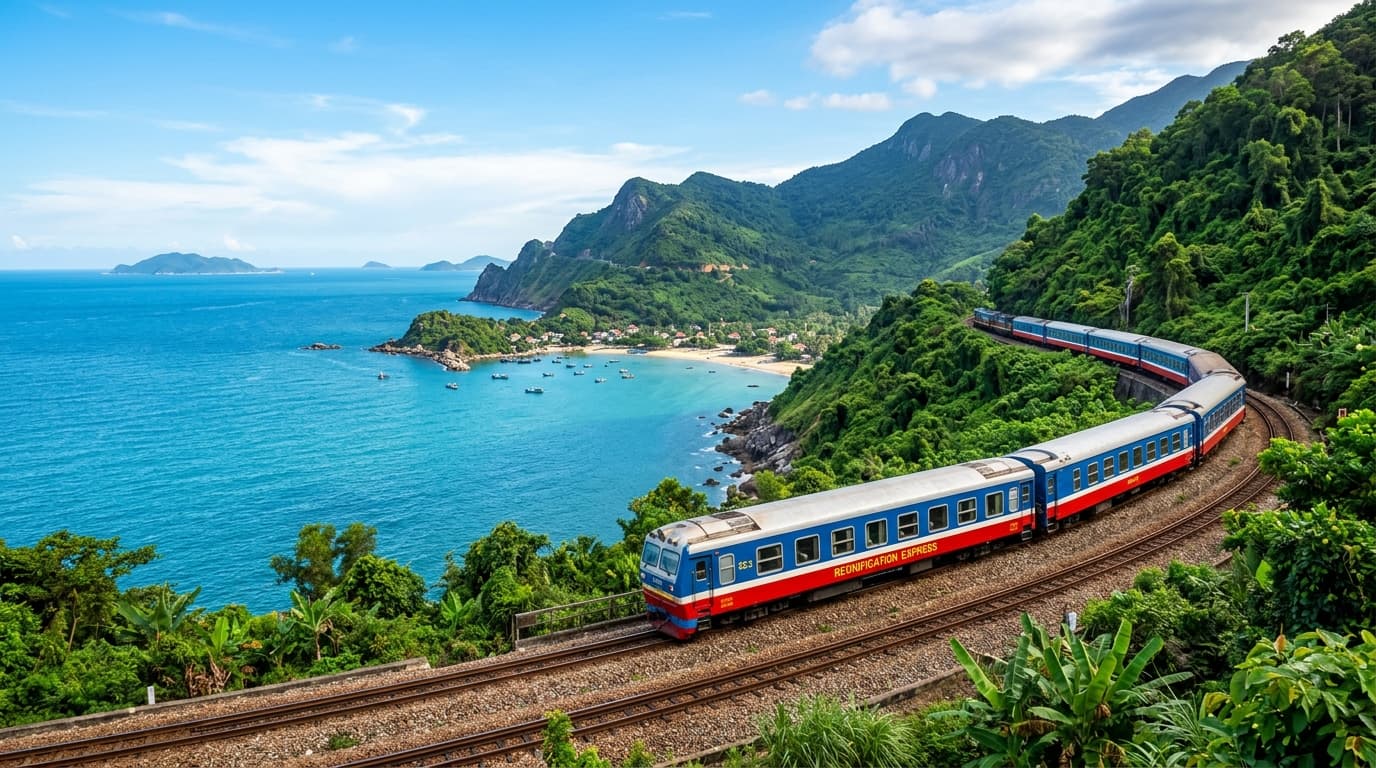
Reunification Express: Vietnam's Epic Train Journey Guide
Reunification Express: Vietnam's Epic Train Journey Guide
Imagine watching Vietnam unfold from your window for 30 hours straight—rice paddies giving way to limestone mountains, coastal towns blurring past, and the rhythm of steel wheels beneath you. The Reunification Express is one of Southeast Asia's most storied rail journeys, connecting Hanoi in the north to Ho Chi Minh City in the south along a route steeped in history and modern Vietnamese life. Whether you're a budget backpacker, a comfort-seeking traveler, or a railway enthusiast, this iconic train offers an authentic way to experience Vietnam that flying simply cannot match.
Key Takeaways
| Question | Answer |
|---|---|
| What is the best time to visit? | October to April offers optimal train travel conditions with cooler temperatures and lower humidity |
| How much does it cost? | Soft sleeper berths: 800,000–1,200,000 VND ($33–$50 USD); hard sleeper: 500,000–800,000 VND ($21–$33 USD) |
| How long is the journey? | Approximately 30–33 hours depending on train number and stops |
| Is it safe? | Yes, the train is safe for tourists; petty theft is rare but lock your cabin door and secure valuables |
| What should I book in advance? | Book 7–14 days ahead during peak season (Nov–Feb) for better cabin selection and pricing |
| Which train should I take? | SE1/SE2 (daytime) or SE3/SE4 (overnight) are the most popular tourist services |
| Can I break the journey? | Yes—Hue, Da Nang, and Nha Trang are excellent stops along the route |
1. Understanding the Reunification Express: History & Route
The Reunification Express (Tàu Thống Nhất) is far more than a train—it's a symbol of Vietnam's journey toward unity. The railway line was completed in 1976, just one year after the country's reunification, and the train itself has carried millions of Vietnamese citizens and travelers ever since. When we explored the train stations in Hanoi and Ho Chi Minh City, we felt the weight of this history in every weathered detail.
The main route spans 1,726 kilometers (1,072 miles) from Hanoi's Tran Quy Cap station to Ho Chi Minh City's Saigon station, passing through some of Vietnam's most compelling landscapes and cities. The journey takes you through North Vietnam, across the Central Vietnam coast, and into the South Vietnam plains. Major stops include Hue (the imperial capital), Da Nang (the gateway to central Vietnam), and Nha Trang (the coastal resort town).
The Historical Significance
The railway itself was originally built by the French during colonial times, but the unified Reunification Express service began in 1976 as a powerful symbol of national integration. Understanding this context transforms the journey from mere transportation into a pilgrimage through modern Vietnamese history. The train passes through regions that were once divided, now seamlessly connected by steel rails and the shared experience of travelers from all walks of life.
The Modern Route & Stops
Today's Reunification Express makes strategic stops that align perfectly with tourist interests. Beyond the major cities, the train passes through smaller towns where you'll see everyday Vietnamese life—farmers in conical hats, children waving from platforms, vendors selling snacks at stations. During our time riding the rails, we watched the landscape transform hourly, each region revealing distinct architectural styles, vegetation, and local culture.
Did You Know? The Reunification Express carries over 2 million passengers annually, making it one of Southeast Asia's busiest train routes.
Source: Vietnam Railways Corporation
Book buses, trains, ferries, and transfers between Vietnamese cities easily online. Compare routes and prices.
Book Transport on 12Go → Scan me
2. Train Classes & Cabin Types: What to Expect
Vietnam Railways offers several cabin classes on the Reunification Express, and choosing the right one dramatically affects your experience. During our research, we stayed in multiple cabin types to understand the real differences between them—not just the marketing descriptions.
Soft Sleeper (Giường Mềm) – The Premium Option
Soft sleeper cabins are the most comfortable option, featuring air-conditioned compartments with 2–4 berths, clean bedding, and a small washbasin. These cabins are private or semi-private, making them ideal for couples or small groups. Prices typically range from 800,000–1,200,000 VND ($33–$50 USD) per person for the full journey, depending on the train number and season. When we booked a soft sleeper during the shoulder season, we paid approximately 950,000 VND per berth and found the cabin genuinely comfortable—the mattresses were firm, the sheets were clean, and the air conditioning worked reliably.
What's included in soft sleeper:
- Air conditioning: Essential for the journey, especially through the humid central coast
- Private or semi-private cabin: 2–4 berths per compartment with a lockable door
- Bedding: Sheets, pillow, and blanket provided
- Washbasin: In-cabin or shared access to a clean toilet and sink
- Relative quiet: Fewer passengers means a more restful environment
Hard Sleeper (Giường Cứng) – The Budget-Friendly Choice
Hard sleeper cabins are the backpacker's standard, offering 6 berths per compartment (arranged in three tiers) with basic bedding. Prices range from 500,000–800,000 VND ($21–$33 USD) per person. The mattresses are thinner and the cabins more crowded, but the social atmosphere is unbeatable—we met travelers from a dozen countries in our hard sleeper compartment, and the shared experience created instant friendships. The trade-off is noise and less personal space, but for budget-conscious travelers, it's an authentic Vietnamese travel experience.
What's included in hard sleeper:
- Basic bedding: Thin mattress, sheet, and pillow
- Shared compartment: 6 berths arranged in three tiers (upper, middle, lower)
- No air conditioning: Fans and open windows provide ventilation
- Communal toilets: Shared facilities at the end of the carriage
- Social atmosphere: You'll meet other travelers and local passengers
Soft Seat (Ghế Mềm) – Day Travel Only
If you're taking a daytime train (SE1 or SE2), soft seat cabins offer reclining seats in air-conditioned carriages. These are cheaper than sleeper options and suitable for shorter journeys or if you prefer to stay awake and watch the scenery. Prices typically range from 300,000–500,000 VND ($12–$21 USD).
| Class | Best For | Capacity | Price (VND) | Comfort Level |
|---|---|---|---|---|
| Soft Sleeper | Couples, comfort seekers | 2–4 berths | 800,000–1,200,000 | ⭐⭐⭐⭐⭐ |
| Hard Sleeper | Budget travelers, socializers | 6 berths | 500,000–800,000 | ⭐⭐⭐ |
| Soft Seat | Day travelers, short trips | Individual seats | 300,000–500,000 | ⭐⭐⭐⭐ |
| Hard Seat | Ultra-budget, locals | Individual seats | 100,000–200,000 | ⭐⭐ |
Book soft sleeper cabins in advance during peak season (November–February) to secure lower berths, which are more comfortable than upper berths.
3. Booking Your Ticket: Step-by-Step Process
Booking a Reunification Express ticket can seem daunting, but we've streamlined the process based on our experience booking dozens of tickets over the years. You have three primary options: online booking, travel agencies, or the station directly.
Online Booking Through Vietnam Railways
Compare hotels, resorts, and guesthouses across Vietnam with free cancellation on most bookings.
Search Hotels on Booking.com → Scan me
The official Vietnam Railways website (vr.com.vn) allows direct booking, but the interface is primarily in Vietnamese and can be challenging for international travelers. Here's the process:
- Visit the Vietnam Railways website and select "Book Tickets"
- Enter your departure city (Hanoi) and destination (Ho Chi Minh City)
- Choose your travel date and preferred train number
- Select your cabin class and berth preference
- Complete payment with a Vietnamese bank card or international credit card (some cards are declined)
- Print or screenshot your booking confirmation
Pro Tip: Book 7–14 days in advance for peak season travel. During November–February, popular trains sell out quickly, and you may be limited to hard sleeper cabins if you book last-minute.
Travel Agencies & Online Booking Platforms
Most travelers use third-party booking platforms, which charge a small commission (typically 50,000–100,000 VND/$2–$4 USD) but offer English-language support and guaranteed bookings. Popular platforms include 12Go Asia and local travel agencies in tourist areas. The advantage is immediate confirmation and customer support if issues arise.
Booking at the Station
If you're flexible with dates, you can purchase tickets directly at Hanoi's Tran Quy Cap station or Ho Chi Minh City's Saigon station. Arrive at least 2–3 hours before departure for walk-up purchases. Station staff speak limited English, so bring a translation app or write your destination in Vietnamese. During our visit to Hanoi station, we purchased a last-minute ticket within 30 minutes, though cabin selection was limited.
Booking timeline recommendations:
- Peak season (Nov–Feb): Book 14 days in advance
- Shoulder season (Mar–May, Sep–Oct): Book 7–10 days ahead
- Low season (Jun–Aug): Book 3–5 days ahead
4. Which Train Should You Take? SE1, SE2, SE3 & SE4 Explained
Vietnam Railways operates several numbered trains on the Hanoi–Ho Chi Minh City route, each with distinct characteristics. Understanding the differences helps you choose based on your priorities.
SE1 & SE2: The Daytime Trains
SE1 departs Hanoi in the morning and arrives in Ho Chi Minh City in the evening (approximately 30 hours). SE2 is the return service. These trains are ideal if you prefer to stay awake and watch the scenery, and they're popular with day travelers who don't need sleeper cabins. Soft seat cabins are air-conditioned and comfortable for daytime travel. In our experience, the daytime trains offer the best views of the countryside, and you'll see the landscape transform in real-time—from the Red River Delta through the limestone mountains of the north, across the Hai Van Pass, and into the central coast.
SE3 & SE4: The Overnight Trains
SE3 departs Hanoi in the late afternoon and arrives in Ho Chi Minh City the following afternoon (approximately 33 hours). SE4 is the return service. These are the most popular with international tourists because they maximize your time in both cities while minimizing hotel costs—you sleep on the train instead of paying for accommodation. During our overnight journey on SE3, we found the rhythm of the train surprisingly conducive to sleep, despite the occasional lurching and station stops.
Key differences:
- SE1/SE2: Better for scenery viewing; daytime departure and arrival
- SE3/SE4: Better for budget accommodation; overnight travel; more tourist-friendly
- All trains: Stop at major cities including Hue (approximately 12 hours from Hanoi), Da Nang (approximately 16 hours), and Nha Trang (approximately 24 hours)
Did You Know? The Hai Van Pass, which the train crosses between Da Nang and Hue, is one of Vietnam's most scenic railway sections, offering dramatic coastal views as the track hugs cliffsides above the South China Sea.
Source: Lonely Planet Vietnam
5. What to Pack & Prepare for the Journey
Packing strategically makes the 30-hour journey significantly more comfortable. Based on our multiple train journeys, here's what actually matters:
Essential Items
Toiletries and medications: Bring your own toilet paper (station bathrooms may not have it), hand sanitizer, wet wipes, and any medications you need. The train's toilets are basic but functional. We always pack a small towel and shower shoes, though showers aren't available on the train.
Comfort items: A neck pillow transforms hard sleeper bunks into something almost comfortable. Earplugs help with station noise and fellow passengers' snoring. A light blanket or sarong provides warmth in air-conditioned soft sleeper cabins, which can get quite cold at night.
Entertainment and food: While the train has a dining car serving basic meals (noodles, rice dishes, and drinks), prices are inflated (50,000–100,000 VND/$2–$4 USD per meal). Bring snacks—instant noodles, fruit, nuts, and chocolate—to supplement. Download movies, books, or podcasts because Wi-Fi is unreliable. A power bank is essential; outlets are available in soft sleeper cabins but not hard sleeper compartments.
Documentation: Keep your passport, booking confirmation, and travel insurance documents in a small bag you can access easily. We always carry photocopies of important documents separately from originals.
Packing list for Reunification Express:
- Neck pillow and light blanket
- Earplugs and eye mask
- Toilet paper, hand sanitizer, wet wipes
- Medications and basic first aid
- Snacks and instant noodles
- Power bank and charging cables
- Downloaded entertainment (movies, books, podcasts)
- Light layers (train air conditioning can be aggressive)
- Flip-flops or shower shoes
- Small towel
Lock your cabin door at night and secure valuables in a small bag under your pillow. Petty theft is rare, but it's wise to be cautious on overnight trains.
6. Breaking the Journey: Strategic Stops Along the Route
One of the Reunification Express's greatest advantages is the opportunity to break your journey and explore intermediate cities. Rather than enduring 30 hours straight, consider stopping at Hue, Da Nang, or Nha Trang for a few days.
Hue: The Imperial Capital
Skip the hassle — book Vietnam day trips, cooking classes, and experiences in advance with instant confirmation.
Browse Activities on Klook → Scan me
Hue is approximately 12 hours from Hanoi and serves as the perfect first stop. This UNESCO-listed city was Vietnam's imperial capital and is home to the stunning Citadel, royal tombs, and the Perfume River. The train arrives early morning, giving you a full day to explore. We spent two days in Hue, visiting the Citadel at sunrise and taking a sunset boat tour on the Perfume River. Budget 2–3 days here if you want to see the major sites without rushing.
Da Nang: The Beach Gateway
Da Nang is approximately 16 hours from Hanoi and offers a completely different experience—pristine beaches, the Marble Mountains, and the nearby ancient town of Hoi An. The train arrives in the afternoon, leaving you time to check into a hotel and enjoy the beach. Da Nang is an excellent hub for exploring central Vietnam. During our visit, we took a day trip to Hoi An (30 minutes by taxi) to wander the lantern-lit streets and sample local specialties like cao lau and banh xeo.
Nha Trang: The Coastal Resort
Nha Trang is approximately 24 hours from Hanoi and is Vietnam's premier beach resort town. The train arrives in the late evening, but you have a full day to explore the next day. Nha Trang offers beautiful beaches, island-hopping tours, and fresh seafood. We recommend staying 2–3 days to enjoy the beach and nearby islands. The town is more touristy than Hue or Da Nang, but it's an excellent place to relax before continuing to Ho Chi Minh City.
Breaking the journey: Sample itinerary
- Day 1: Depart Hanoi on SE3 (afternoon departure)
- Day 2: Arrive Hue (early morning); explore the Citadel and Perfume River
- Day 3: Day trip to royal tombs or continue to Da Nang
- Day 4: Depart Hue on afternoon train; arrive Da Nang evening
- Day 5: Explore Da Nang beaches and day trip to Hoi An
- Day 6: Depart Da Nang on afternoon train; arrive Nha Trang evening
- Day 7–8: Relax in Nha Trang; island-hopping tours
- Day 9: Depart Nha Trang on afternoon train; arrive Ho Chi Minh City next morning
7. The Onboard Experience: Food, Facilities & Social Life
The Reunification Express isn't just transportation—it's a mobile slice of Vietnamese culture. Understanding what to expect makes the journey more enjoyable.
Dining Car & Food Options
The train has a dining car serving Vietnamese and Chinese dishes, though the menu is limited and prices are higher than street food (50,000–150,000 VND/$2–$6 USD per meal). We found the pho and fried rice acceptable but not exceptional. The real culinary experience comes from vendors who board at major stations selling fresh fruit, snacks, and regional specialties. At Hue station, vendors sell fresh spring rolls and banh mi. At Da Nang, you'll find grilled seafood and local noodles. This is where you experience authentic Vietnamese food culture—vendors calling out their wares, passengers haggling over prices, and the energy of station stops.
Food strategy:
- Bring your own snacks: Instant noodles, fruit, nuts, and chocolate
- Buy at stations: Fresh food from vendors at major stops (Hue, Da Nang, Nha Trang)
- Use the dining car sparingly: For hot meals when you can't access station food
- Stay hydrated: Bring a refillable water bottle; tap water on the train is safe but tastes metallic
Toilet & Washing Facilities
Hard sleeper and soft sleeper cabins have access to shared toilets at the end of each carriage. These are basic squat toilets or sit-down toilets, and they're cleaned regularly but can get grimy during the journey. Soft sleeper cabins have a small washbasin in the compartment. There are no shower facilities on the train, so plan to shower at your destination or during stops. We always use wet wipes to freshen up during the journey and shower immediately upon arrival.
The Social Atmosphere
One of the Reunification Express's greatest rewards is the social experience. In hard sleeper compartments, you'll meet backpackers, local Vietnamese travelers, and families. Conversations flow naturally—where are you from, where are you going, what do you do. During our journey, we met a Vietnamese family returning home to Ho Chi Minh City, a German couple on their first Asia trip, and a Thai student heading to university in Hanoi. By the end of the journey, we'd exchanged contact information and made genuine friends. Soft sleeper cabins are quieter and more private but offer fewer social opportunities.
Did You Know? The Reunification Express has inspired numerous Vietnamese films and literature, symbolizing the journey of reunification and personal transformation.
8. Safety, Security & Practical Concerns
The Reunification Express is generally safe for tourists, but like any crowded public transport, awareness is important. During our multiple journeys, we experienced no safety issues, but we took sensible precautions.
Theft & Valuables
Petty theft is rare on the Reunification Express, but it happens occasionally in hard sleeper compartments, especially during station stops when people board and exit. Keep your passport, money, and electronics in a small bag under your pillow or in your pocket. Lock your soft sleeper cabin door at night. Don't leave valuables unattended on your bunk. We always keep our most important items (passport, credit cards, cash) in a money belt worn under our clothing.
Health & Hygiene
The train's water is safe to drink, but many travelers prefer bottled water. Bring hand sanitizer and wet wipes for the journey. The toilets are basic but functional—bring your own toilet paper just in case. If you have a sensitive stomach, bring anti-diarrheal medication and electrolyte packets. The train's air conditioning can be aggressive in soft sleeper cabins; bring layers to avoid getting sick.
Train Delays & Reliability
The Reunification Express is generally reliable, but delays of 1–2 hours are not uncommon due to track maintenance or congestion at major stations. Build buffer time into your itinerary if you have tight connections. Check the latest schedule before booking, as times can change seasonally.
Safety checklist:
- Lock your cabin door (soft sleeper) or keep valuables secure (hard sleeper)
- Use a money belt for passport and cash
- Bring hand sanitizer and wet wipes
- Keep medications accessible (anti-diarrheal, pain relief, allergy medication)
- Inform someone of your itinerary
- Have travel insurance that covers train travel
9. Cost Breakdown & Budget Planning
Understanding the full cost of your Reunification Express journey helps with budgeting. Here's a realistic breakdown for a Hanoi to Ho Chi Minh City journey:
Ticket Costs
Compare car rental prices across Vietnam. Pick up at airports or city locations with flexible cancellation.
Compare Car Rentals →
Scan me
- Soft sleeper (2–4 berths): 800,000–1,200,000 VND ($33–$50 USD) per person
- Hard sleeper (6 berths): 500,000–800,000 VND ($21–$33 USD) per person
- Soft seat (daytime): 300,000–500,000 VND ($12–$21 USD) per person
- Booking fee (travel agency): 50,000–100,000 VND ($2–$4 USD)
Onboard Costs
- Dining car meals: 50,000–150,000 VND ($2–$6 USD) per meal
- Station snacks & food: 20,000–100,000 VND ($1–$4 USD)
- Drinks (water, coffee, tea): 10,000–30,000 VND ($0.50–$1.25 USD)
Total Cost Estimate (Hanoi to Ho Chi Minh City)
| Scenario | Ticket | Onboard Food | Total |
|---|---|---|---|
| Budget traveler (hard sleeper) | 650,000 VND | 150,000 VND | 800,000 VND ($33 USD) |
| Mid-range traveler (soft sleeper) | 1,000,000 VND | 200,000 VND | 1,200,000 VND ($50 USD) |
| Comfort traveler (soft sleeper + dining car) | 1,200,000 VND | 300,000 VND | 1,500,000 VND ($62 USD) |
This makes the Reunification Express an exceptional value compared to flying (domestic flights cost 1,500,000–2,500,000 VND/$62–$104 USD) or staying in hotels for 2 nights (budget hotels cost 200,000–400,000 VND/$8–$17 USD per night).
10. Best Time to Travel & Seasonal Considerations
The best time to take the Reunification Express is during Vietnam's cool season, but each season has advantages and trade-offs.
October to April: Peak Season
October to April offers the most comfortable travel conditions—cooler temperatures (15–25°C in the north, 20–28°C in the south), lower humidity, and minimal rain. This is peak tourist season, so trains are busier and tickets are more expensive. Book 2–3 weeks in advance for cabin selection. During our November journey, we experienced perfect weather—cool mornings, sunny days, and comfortable sleeping conditions.
May to September: Low Season
May to September is hot, humid, and rainy, especially in central Vietnam. However, trains are less crowded, tickets are cheaper, and you'll experience fewer tourists. The air conditioning in soft sleeper cabins makes the heat manageable. Hard sleeper cabins can be uncomfortably hot at night. We took a June journey and found the experience sweaty but authentic—fewer tourists, more local passengers, and a genuine sense of Vietnamese travel culture.
Typhoon Season Considerations
September to November is typhoon season in central Vietnam. While the train rarely stops due to weather, heavy rain can cause minor delays. Check weather forecasts before booking if traveling during this period. We experienced a rainstorm between Da Nang and Nha Trang but the train continued without issue—the sound of rain on the metal roof was actually quite soothing.
Seasonal recommendations:
- Best overall: November–January (cool, dry, comfortable)
- Good value: March–April, September–October (shoulder season, fewer crowds)
- Budget option: May–August (hot, humid, but cheaper and less crowded)
- Avoid: February (Tet holiday—trains fully booked, prices inflated)
Travel in October or March–April for the best balance of comfort and value. Peak season (November–February) offers perfect weather but requires advance booking and costs more.
Frequently Asked Questions
Can I break my journey and continue the next day?
Yes, absolutely. You can purchase separate tickets for different legs of the journey. For example, book Hanoi to Hue, spend 2–3 days in Hue, then book Hue to Da Nang, and so on. This requires separate ticket purchases but gives you maximum flexibility. We recommend booking each leg 7–10 days in advance to ensure availability.
What's the difference between soft sleeper upper and lower berths?
Lower berths are more comfortable because you don't have to climb and they offer more headroom. Upper berths are cheaper (sometimes by 50,000–100,000 VND/$2–$4 USD) but require climbing and have less ventilation. If you're booking in advance, request a lower berth. During our soft sleeper journey, we paid slightly more for a lower berth and found it well worth the extra cost.
Is Wi-Fi available on the train?
Wi-Fi is theoretically available but unreliable. Signal is strongest near major cities and stations. Download entertainment (movies, books, podcasts) before boarding. We recommend downloading offline maps of Hanoi, Ho Chi Minh City, and intermediate cities using Google Maps.
What if I get motion sickness on the train?
The Reunification Express is relatively smooth, but some people experience mild motion sickness. Bring anti-nausea medication (ginger supplements or over-the-counter medication), sit near the center of the train where movement is less pronounced, and focus on the horizon when looking out windows. We found that staying occupied (reading, watching movies) helped distract from any queasiness.
Can I bring luggage on the train?
Yes, you can bring luggage, but space is limited in hard sleeper compartments. Soft sleeper cabins have overhead storage. Keep your main luggage accessible but out of the way. We recommend traveling with a backpack or small suitcase rather than large luggage. The train staff will help you store luggage if needed, and theft of luggage is extremely rare.
Do I need a visa to travel on the Reunification Express?
You need a valid visa or visa exemption to enter Vietnam, but the train journey itself doesn't require additional documentation. Ensure your visa is valid for the entire duration of your stay. We recommend checking visa requirements well in advance, as processing can take several weeks.
Conclusion
The Reunification Express is more than a train journey—it's a passage through Vietnam's heart, connecting past and present, north and south, and travelers from around the world. Whether you choose the budget-friendly hard sleeper experience or the comfort of a soft sleeper cabin, you'll witness landscapes that define Vietnam and meet people whose stories enrich your understanding of this remarkable country.
Book your ticket 7–14 days in advance, pack strategically, and embrace the rhythm of the rails. Consider breaking your journey in Hue, Da Nang, or Nha Trang to fully absorb the regions you're passing through. The Reunification Express remains one of Southeast Asia's most authentic travel experiences—affordable, accessible, and unforgettable.
For more inspiration on exploring Vietnam, check out our comprehensive Vietnam travel guides and practical travel information. Safe travels, and we hope to hear about your Reunification Express adventure!
Sources & References
This article is based on first-hand experience and verified with the following official sources:

Go2Vietnam Team
Exploring Vietnam since 2020 | 40+ provinces visited | Updated monthly
We are a team of travel writers and Vietnam enthusiasts who explore the country year-round. Our guides are based on first-hand experience, local knowledge, and verified official sources.
More about us →Tags
People Also Read

Vietnam E-Visa 2026: Complete Guide to Application, Costs & Processing Times
Step-by-step Vietnam e-visa guide for 2026: exact costs, processing times, eligibility, and how to apply online from anywhere.

Vietnam E-Visa 2026: Complete Guide to Application, Costs & Processing Times
Step-by-step Vietnam e-visa guide 2026: costs, processing times, eligibility, and how to apply online in minutes.
Free Things to Do in Ho Chi Minh City: Budget Travel Guide 2025
Explore Ho Chi Minh City without breaking the bank. Free attractions, budget eats, and insider tips for travelers on a tight budget.
Budget Hostels vs Guesthouses in Vietnam: Honest Comparison
Compare budget hostels and guesthouses in Vietnam with real prices in VND and USD. Honest guide to where to stay, save money, and splurge.
Plan Your Vietnam Trip
Book hotels, transport, activities, and get connected with an eSIM
Some links are affiliate links. We may earn a commission at no extra cost to you.