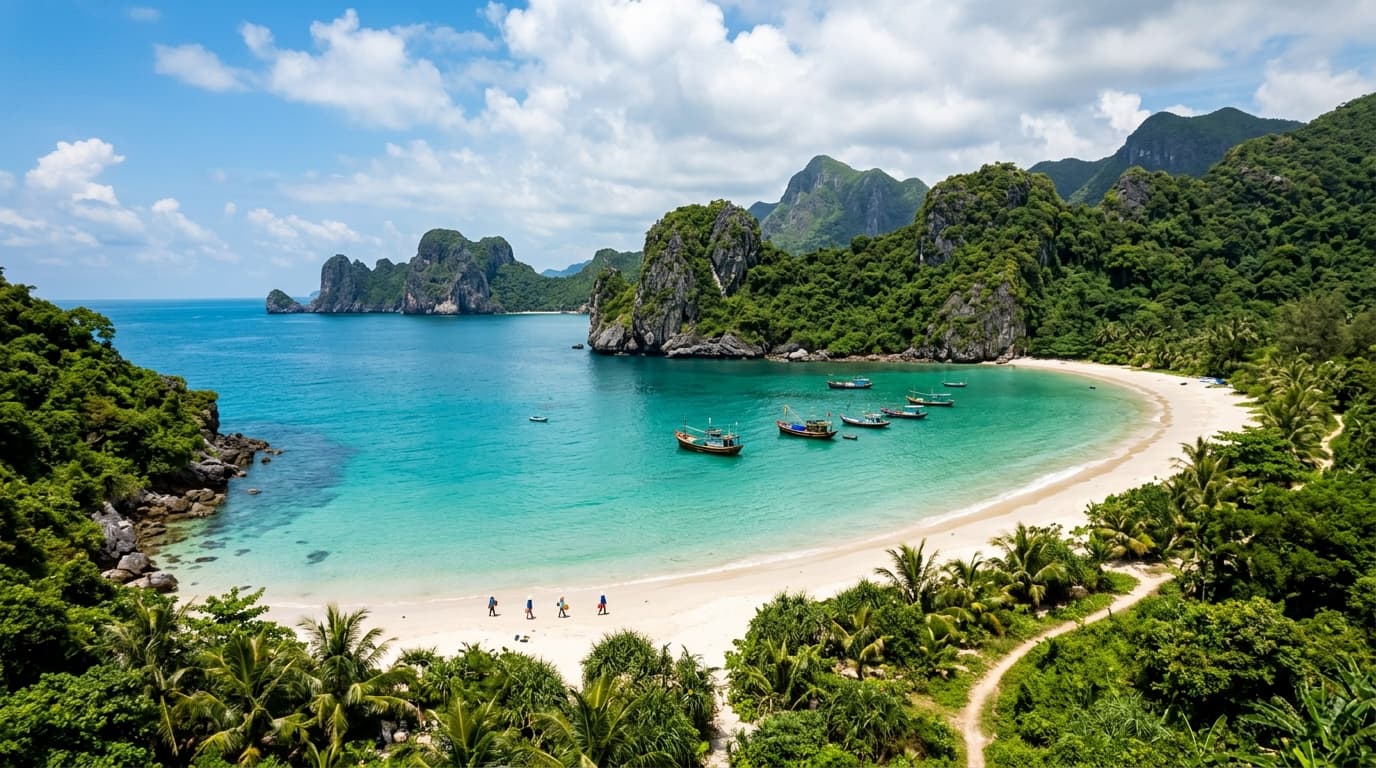
When most travelers think of Vietnamese islands, they picture the crowded limestone karsts of Ha Long Bay or the developed beaches of Phu Quoc. But Con Dao Islands remain Southeast Asia's best-kept secret—a place where pristine white-sand beaches meet untouched jungle, where history whispers from colonial ruins, and where you can actually hear yourself think. This 16-island archipelago off the southern coast of Vietnam feels genuinely removed from the tourist circuit, yet it's surprisingly accessible once you know how to get there.
Key Takeaways
| Question | Answer |
|---|---|
| What is the best time to visit? | November to April offers calm seas and clear skies; avoid May-October monsoon season |
| How much does it cost? | Budget: 500,000-800,000 VND/day; Mid-range: 1-2 million VND/day; Splurge: 2+ million VND/day |
| How do I get there? | Fly from Ho Chi Minh City to Con Dao airport (45 minutes) or take a ferry from Vung Tau |
| Is it safe? | Very safe—minimal crime, excellent healthcare, stable infrastructure |
| What should I book in advance? | Flights during peak season (Dec-Feb), accommodation on the main island, boat tours to outer islands |
| How many days should I spend? | 3-5 days minimum; 7 days ideal to explore multiple islands and relax |
| What's the main draw? | Solitude, snorkeling, hiking, colonial history, and some of Vietnam's best-preserved coral reefs |
1. Understanding Con Dao: Geography and History
Con Dao Islands comprise 16 islands scattered across the Gulf of Thailand, with Con Son (also called Phu Quoc's quieter cousin) serving as the main hub. The archipelago sits about 180 kilometers south of Ho Chi Minh City, close enough for a quick flight but far enough to feel genuinely remote. When we explored the islands, what struck us most was the absence of jet skis, beach vendors, and the constant hum of development that characterizes other Vietnamese beach destinations.
The islands carry profound historical weight. During the French colonial period and the Vietnam War, Con Dao served as a notorious prison complex—the "Alcatraz of Southeast Asia." Today, Con Son Island's Prison Museum stands as a sobering reminder of that era, but the islands have transformed into a place of healing and natural beauty. The combination of dark history and pristine present creates an unexpectedly moving destination.
Colonial Legacy and Modern Transformation
The French built elegant colonial architecture here in the 1800s, and you'll still find weathered villas, a charming French-style church, and tree-lined streets that feel frozen in time. The prison itself—now a museum—is both educational and emotionally heavy; it's not a cheerful tourist attraction but rather a genuine historical site that demands respect. Many visitors find themselves spending hours here, reading individual prisoner stories and contemplating the resilience of the Vietnamese people.
The Untouched Natural Environment
What makes Con Dao special isn't just history—it's the pristine ecosystems that surround the islands. The waters here remain relatively undeveloped, which means coral reefs are healthier than in many Southeast Asian destinations, and marine biodiversity is genuinely impressive. During our time snorkeling around the outer islands, we spotted parrotfish, angelfish, and even sea turtles in waters so clear we could see 15+ meters down.
Did You Know? Con Dao's marine protected areas have helped preserve over 1,200 species of fish and 200+ species of coral, making it one of Southeast Asia's most biodiverse reef systems.
2. Getting There: Flights, Ferries, and Logistics
Getting to Con Dao Islands is straightforward but requires planning, especially during peak season. Most visitors fly from Ho Chi Minh City, which is the fastest and most reliable option. The flight takes just 45 minutes and costs around 1.5-2.5 million VND (roughly $60-100 USD) for a return ticket, depending on how far in advance you book. The airport is small and charming—no chaos, no crowds, just efficient service.
Some links in this guide are affiliate links — if you book through them, we earn a small commission at no extra cost to you, which helps us keep this site running.
Flight Options and Timing
Vietnam Airlines operates the primary route from Ho Chi Minh City, with flights typically departing in the morning. During peak season (December-February), book at least 2-3 weeks in advance. The return flight usually departs in the afternoon, giving you a full day on the islands. The airport itself is a 10-minute motorbike ride from the main town, Con Son, making transfers quick and inexpensive.
Ferry Alternative
For budget travelers or those seeking adventure, ferries run from Vung Tau (a coastal city about 2 hours from Ho Chi Minh City) to Con Dao. The journey takes 4-6 hours depending on sea conditions and costs around 300,000-500,000 VND. We've heard mixed reviews—some travelers love the experience, others found it uncomfortable during rough seas. The ferry is most reliable during calm months (November-March).
Getting Around the Islands
Once you arrive, getting around Con Dao requires a mix of motorbike rentals and boat tours. Renting a motorbike costs about 100,000-150,000 VND per day and is essential for exploring Con Son Island's interior and reaching quieter beaches. For the outer islands, you'll need to arrange boat tours through your accommodation or local tour operators—expect to pay 800,000-1.5 million VND per person for a full-day excursion.
- Motorbike rental: 100,000-150,000 VND/day; get an international license or use a local driver
- Boat tours: 800,000-1.5 million VND/person for full-day island-hopping
- Local taxis: Available but limited; agree on prices beforehand
- Walking: Con Son town is compact and walkable; most attractions within 2-3 km
3. Best Beaches: Where to Swim and Sunbathe
Con Dao's beaches are its primary draw, and unlike crowded alternatives in Nha Trang or Phu Quoc, you'll often find yourself alone on stretches of pristine sand. The main island, Con Son, has several excellent beaches, each with distinct character. The outer islands offer even more seclusion but require boat access.
An Hai Beach: The Main Hub
An Hai Beach is Con Son Island's primary beach, where most visitors base themselves. It's a long, gently curving bay with soft sand, calm waters, and a handful of beachfront restaurants. During our visit in January, we found it pleasantly busy but never crowded—perhaps 50-100 people spread across a kilometer of sand. The water here is warm year-round (25-28°C) and safe for swimming. The beach has a relaxed vibe; you'll see local families, a few tourists, and plenty of space to claim your own patch of sand.
Dat Doc Beach: Quiet and Undeveloped
If An Hai feels too touristy, Dat Doc Beach on the island's eastern side offers genuine solitude. It's a 15-minute motorbike ride from town and rewards you with a pristine crescent of white sand backed by jungle. There are no facilities here—no restaurants, no vendors, no shade except trees—so come prepared with water, snacks, and sunscreen. This is where you go to truly disconnect.
- Best for: Solitude seekers, photographers, sunset watching
- Facilities: None; bring everything you need
- Water conditions: Generally calm; check with locals during monsoon season
- Accessibility: Motorbike required; rough road in places
Outer Island Beaches: An Binh and Tai
The real magic happens on the outer islands, particularly An Binh and Tai islands. These require boat tours (usually 4-6 hours) but reward you with some of Vietnam's most pristine beaches. An Binh Island has a small fishing village and a gorgeous crescent beach where you can snorkel directly from the shore. Tai Island is even more remote—a true castaway experience with white sand, turquoise water, and absolutely nobody around.
4. Snorkeling and Diving: Marine Adventures
Con Dao Islands boast some of Vietnam's healthiest coral reefs and clearest waters, making snorkeling and diving exceptional here. The marine environment is genuinely impressive—we've snorkeled in many Southeast Asian destinations, and the clarity and biodiversity here rival anything we've experienced in Thailand or Indonesia.
Snorkeling: Accessible and Rewarding
You don't need to be a certified diver to enjoy Con Dao's underwater world. Most boat tours include snorkeling stops, and the experience is accessible even for nervous swimmers. The water is typically 25-28°C year-round, visibility ranges from 10-20 meters, and marine life includes parrotfish, angelfish, grouper, snappers, and occasionally sea turtles and reef sharks (harmless). Local tour operators provide basic snorkeling gear, though bringing your own ensures proper fit.
Scuba Diving: For Certified Divers
Con Dao has several dive sites suitable for different skill levels. Popular spots include Cau Island (good for beginners), An Binh Island (intermediate), and deeper sites around the outer islands (advanced). A single dive costs around 1.2-1.8 million VND, including equipment and guide. The season runs year-round, though November-April offers the best visibility and calmest conditions.
- Beginner dives: Cau Island, An Binh Island; 10-15 meter depth
- Intermediate dives: Outer island sites; 15-25 meter depth
- Advanced dives: Deep reef sites; 25+ meter depth
- Certification courses: Available through local operators; PADI Open Water roughly 3-4 million VND
5. Historical Sites: Prison Museum and Colonial Remnants
Con Dao's history is dark but essential to understanding modern Vietnam. The Con Dao Prison Museum is the archipelago's most visited historical site, and it's genuinely moving rather than sensationalized. Built by the French in the 1860s and later expanded by the South Vietnamese government, the prison held political prisoners, revolutionaries, and war resistors under brutal conditions.
The Prison Museum Experience
Walking through the prison cells—some barely larger than a closet—is sobering. Individual prisoner stories are documented with photographs and biographical information. The museum doesn't shy away from the violence and suffering that occurred here; instead, it presents history respectfully and educationally. Plan 2-3 hours for a thorough visit. Admission costs around 50,000 VND, and English-language guides are available for an additional fee.
Colonial Architecture and the French Church
Beyond the prison, Con Son Island preserves charming colonial-era buildings. The French-style church, built in the 1880s, still stands in the town center with its original architecture largely intact. The governor's mansion, now a museum, offers insights into colonial-era life. These sites are free to explore and provide context for understanding the island's transformation from colonial outpost to modern destination.
6. Accommodation: Where to Stay on Con Dao
Con Dao's accommodation ranges from budget guesthouses to upscale resorts, though nothing here matches the mega-resort scale of Phu Quoc. This is actually a strength—development remains measured and respectful of the environment. Most visitors base themselves on Con Son Island, though some splurge on overnight stays on outer islands.
Budget Options: Guesthouses and Family-Run Hotels
Budget travelers will find clean, simple guesthouses in Con Son town for 300,000-600,000 VND per night. These are typically Vietnamese-run, family-owned places with basic but comfortable rooms, friendly owners, and good local knowledge. Many include breakfast and can arrange tours. During our stays, we found the hospitality genuine and the value excellent.
Mid-Range Hotels: Comfort and Character
Mid-range options (1-2 million VND per night) offer more comfort, often with beachfront locations, better amenities, and organized tour services. Several boutique hotels have opened in recent years, blending colonial architecture with modern comfort. These places often have excellent restaurants and can arrange private boat tours.
Luxury Resorts: Splurge-Worthy Experiences
For those seeking luxury, a handful of upscale resorts offer beachfront villas, spa services, and fine dining—typically 2-4 million VND per night. These properties are small (under 50 rooms) and maintain the island's low-key atmosphere while providing high-end comfort.
| Accommodation Type | Best For | Price Range | Notes |
|---|---|---|---|
| Budget Guesthouses | Backpackers, budget travelers | 300,000-600,000 VND | Family-run, authentic, good local knowledge |
| Mid-Range Hotels | Couples, small groups | 1-2 million VND | Beachfront, organized tours, better amenities |
| Boutique Hotels | Travelers seeking character | 1.5-2.5 million VND | Colonial charm, personalized service |
| Luxury Resorts | Honeymooners, luxury seekers | 2-4+ million VND | Private villas, spa, fine dining, small scale |
7. Food and Dining: Fresh Seafood and Local Flavors
Con Dao's culinary scene revolves around fresh seafood—it's an island, after all, and the daily catch is exceptional. Unlike touristy beach destinations where food caters to Western palates, Con Dao's restaurants serve genuine Vietnamese coastal cuisine. You'll find grilled fish, crab, shrimp, and squid prepared simply to highlight the quality of ingredients.
Local Seafood Restaurants
The best meals happen at humble seafood restaurants along An Hai Beach or in the town center. You'll typically choose your fish from a tank or cooler, specify how you want it prepared (grilled, steamed, fried), and eat it within an hour. Prices are remarkably reasonable—a whole grilled fish with rice and vegetables costs 150,000-300,000 VND. English menus are rare, but pointing and smiling works perfectly.
Vietnamese Coastal Specialties
Beyond standard seafood, Con Dao specializes in dishes you won't find inland. Fresh crab prepared with tamarind, grilled squid with garlic, and steamed grouper with ginger are local favorites. If you're adventurous, try the local specialty of sea urchin (when in season). Pair meals with bia hoi (fresh draft beer) or nuoc mia (fresh sugarcane juice).
- Fresh grilled fish: 150,000-300,000 VND per whole fish
- Crab dishes: 200,000-400,000 VND per plate
- Squid and shrimp: 150,000-250,000 VND per plate
- Rice and vegetables: 30,000-50,000 VND per side
8. Activities Beyond Beaches: Hiking, Kayaking, and Exploration
While beaches dominate Con Dao's appeal, the islands offer plenty of non-beach activities for those seeking variety. Jungle hiking, kayaking, and island exploration provide different perspectives on the archipelago's natural beauty.
Jungle Hiking and Nature Trails
Con Son Island has several hiking trails through dense jungle, offering chances to spot wildlife and enjoy panoramic views. The most popular route climbs to Nui Mot (One Mountain), the island's highest point at 521 meters. The hike takes 2-3 hours round trip and rewards you with 360-degree views of the archipelago. The trail is well-marked but steep in places; wear proper hiking shoes and bring plenty of water.
Kayaking and Paddling
Kayaking around Con Dao's quieter coves and mangrove areas provides a peaceful way to explore. Several tour operators offer half-day kayaking trips (500,000-800,000 VND per person) through calm waters, often combined with snorkeling. This is ideal for travelers seeking a slower pace and more intimate connection with the marine environment.
Island-Hopping and Exploration
Beyond the main island, boat tours visit smaller islands for exploration, swimming, and snorkeling. An Binh Island has a small fishing village where you can interact with locals and see traditional fishing practices. Tai Island offers pure wilderness—no facilities, no people, just pristine beach and jungle. These experiences feel genuinely adventurous compared to typical beach tourism.
9. Best Time to Visit: Seasons and Weather
Con Dao Islands have a tropical climate with distinct wet and dry seasons. The best time to visit is November through April, when skies are clear, seas are calm, and humidity is lower. The monsoon season (May-October) brings heavy rain and rough seas, making boat tours unreliable and some outer islands inaccessible.
Dry Season: November to April
This is peak season, and for good reason. Daytime temperatures hover around 28-32°C, water is calm, and visibility for snorkeling is excellent. December and January are the busiest months, so book accommodation and flights well in advance. February-April remains pleasant with fewer crowds and lower prices. We visited in January and found the balance of good weather and manageable crowds ideal.
Monsoon Season: May to October
During monsoon months, rainfall is heavy (particularly July-September), seas are rough, and many boat tours are cancelled. Accommodation prices drop significantly, and you'll have beaches largely to yourself—but you'll also spend considerable time indoors. If you visit during this period, focus on the main island's indoor attractions (Prison Museum, colonial sites) and accept that outer island trips may not happen.
Did You Know? Con Dao receives an average of 2,000-2,500mm of rainfall annually, with most precipitation occurring during the May-October monsoon season.
10. Practical Information: Money, Health, and Safety
Con Dao is remarkably safe, well-developed, and easy to navigate for travelers. Healthcare is adequate, though serious medical issues may require evacuation to Ho Chi Minh City. The archipelago is stable, crime is minimal, and locals are genuinely welcoming to visitors.
Money and Costs
Vietnam uses the Vietnamese Dong (VND). ATMs are available in Con Son town, though it's wise to bring cash as backup. Credit cards work at larger hotels and restaurants but not at small family-run establishments. Budget travelers can eat, sleep, and explore for 500,000-800,000 VND per day; mid-range travelers should budget 1-2 million VND daily; luxury travelers will spend 2+ million VND.
Health and Medical Care
Con Son has a basic hospital with English-speaking staff for minor issues. For serious medical emergencies, evacuation to Ho Chi Minh City is standard. Travel insurance is highly recommended. Tap water is generally safe, though many travelers drink bottled water. Dengue fever and other mosquito-borne illnesses are possible; use insect repellent, especially during dawn and dusk.
Safety and Security
Con Dao is genuinely safe. Violent crime is virtually non-existent, petty theft is rare, and locals are respectful of visitors. Standard precautions apply—don't leave valuables unattended on beaches, secure your motorbike, and avoid walking alone late at night in unfamiliar areas. The police presence is minimal but friendly.
Getting Connected
Mobile networks are reliable; both Viettel and Mobifone offer good coverage. Getting a local SIM card is straightforward and costs around 50,000 VND with data packages available. WiFi is available at most hotels and restaurants, though speeds vary. For staying connected throughout Vietnam, consider an eSIM option before arrival.
Frequently Asked Questions
How many days should I spend in Con Dao?
Three days is the minimum to experience the main attractions—one day for the Prison Museum and colonial sites, one day for beach relaxation, and one day for snorkeling or island-hopping. Five to seven days is ideal if you want to explore multiple outer islands, hike, and genuinely disconnect without feeling rushed.
Is Con Dao expensive compared to other Vietnamese islands?
Con Dao is moderately priced—more expensive than budget destinations like Cat Ba Island but comparable to or slightly cheaper than Phu Quoc. Flights from Ho Chi Minh City add to the cost, but accommodation and food are reasonable. Budget travelers can manage on 500,000-800,000 VND daily.
Can I visit Con Dao as a day trip from Ho Chi Minh City?
Technically yes, but it's not recommended. The flight takes 45 minutes each way, and you'd spend half your day traveling. An overnight stay is minimum; 2-3 nights allows you to actually relax and explore.
What should I pack for Con Dao?
Bring sunscreen (SPF 50+), insect repellent, lightweight clothing, a light rain jacket (even in dry season), snorkeling gear if you have your own, and comfortable hiking shoes. Pharmacies in Con Son town stock basics if you forget anything.
Is Con Dao suitable for families with children?
Absolutely. The beaches are safe, the pace is relaxed, and there's minimal traffic or pollution. Snorkeling is accessible for kids, and the Prison Museum is educational (though emotionally heavy). Some families skip the prison and focus on beaches and nature.
Can I rent a motorbike without an international license?
Technically, you need an international driving permit, though enforcement is lax. Many travelers rent without one, but it's your responsibility if stopped. Hiring a local driver for the day costs around 300,000-500,000 VND and removes the legal gray area.
What's the best way to see the outer islands?
Book a full-day boat tour through your hotel or a local tour operator. Tours typically cost 800,000-1.5 million VND per person and include snorkeling, lunch, and visits to 2-3 islands. Small group tours (4-8 people) offer better experiences than large group tours.
Conclusion
Con Dao Islands represent something increasingly rare in Southeast Asia: a genuinely undeveloped, authentic island destination that hasn't sacrificed its character for tourism. The combination of pristine beaches, excellent snorkeling, fascinating history, and genuine solitude makes it Vietnam's most compelling island destination for travelers seeking something beyond the typical beach resort experience.
Whether you're a history buff drawn to the Prison Museum, a snorkeler eager to explore healthy coral reefs, or simply someone craving peace and quiet, Con Dao delivers. The islands feel like a secret—not because they're hidden, but because most travelers don't know they exist. That's changing slowly, and we suspect Con Dao's low-key charm won't last forever. Visit now, while it still feels like discovering something special.
Ready to plan your Con Dao adventure? Start by exploring our comprehensive island guides to compare Con Dao with other Vietnamese destinations, then check our practical travel information for visas, transportation, and other essentials. For flights from Ho Chi Minh City, our transport guides have detailed booking advice.
Trust us: We've explored Vietnam extensively, lived in its cities, and traveled its backroads. Con Dao isn't just another beach destination—it's a reminder of why we fell in love with Vietnam in the first place.
Sources & References
This article is based on first-hand experience and verified with the following official sources:

Go2Vietnam Team
Exploring Vietnam since 2020 | 40+ provinces visited | Updated monthly
We are a team of travel writers and Vietnam enthusiasts who explore the country year-round. Our guides are based on first-hand experience, local knowledge, and verified official sources.
More about us →People Also Read

Vietnam E-Visa 2026: How to Apply, Costs & Processing Time
Complete guide to Vietnam e-visa in 2026: step-by-step application, exact costs, processing times, and common mistakes to avoid.

Vietnam E-Visa 2026: How to Apply, Costs & Processing Time
Complete guide to Vietnam e-visa 2026: step-by-step application, exact costs, processing times, and eligibility. Apply online in minutes.
Vietnam E-Visa 2026: How to Apply, Costs & Processing Time
Complete guide to Vietnam E-Visa 2026: step-by-step application process, exact costs, processing times, and everything you need to know before traveling.
Vietnam E-Visa 2026: Complete Guide to Application, Costs & Processing Time
Step-by-step Vietnam e-visa guide for 2026: application process, exact costs, processing times, and answers to common questions.
Plan Your Vietnam Trip
Book hotels, transport, activities, and get connected with an eSIM
Some links are affiliate links. We may earn a commission at no extra cost to you.