
Vietnam E-Visa 2026: How to Apply, Costs & Processing Time
Vietnam E-Visa 2026: How to Apply, Costs & Processing Time
Planning a trip to Vietnam? The Vietnam e-visa has become the fastest and most convenient entry method for international travelers, replacing the need to visit an embassy or use expensive visa agencies. Whether you're heading to the bustling streets of Hanoi, the colonial charm of Hoi An, or island-hopping around Phu Quoc, understanding the e-visa process will save you time, money, and stress.
Key Takeaways
| Question | Answer |
|---|---|
| What is a Vietnam e-visa? | An electronic visa issued online by Vietnam Immigration Department, valid for single or multiple entries |
| How much does it cost? | Single-entry: $25 USD; Multiple-entry: $50 USD (official government fees only) |
| How long does processing take? | Standard: 3 business days; Expedited: 1 business day; Rush: same-day (fees apply) |
| Who can apply? | Citizens of 200+ countries and territories; check eligibility on the official portal |
| What documents do I need? | Valid passport (6+ months validity), passport photo (digital), and completed application form |
| Can I apply after arriving in Vietnam? | No; e-visa must be obtained before arrival and presented at immigration |
| How long is it valid? | 90 days from issue date; allows 30-day stay for single-entry, 90-day for multiple-entry |
1. What Exactly Is a Vietnam E-Visa?
The Vietnam e-visa is an official electronic travel authorization issued directly by Vietnam's Immigration Department, eliminating the need to visit a Vietnamese embassy or consulate. It's a digital document that grants permission to enter Vietnam and is valid for either single or multiple entries within a 90-day window from the date of issue.
When we researched the evolution of Vietnam's visa system, the shift to e-visas represented a major modernization. The system launched officially in 2019 and has processed millions of applications since. Today, it's the preferred method for most international travelers—faster, cheaper, and entirely online.
How It Differs from Other Visa Types
The e-visa is distinct from traditional stamped visas obtained at embassies or consulates. Unlike visa-on-arrival services (which still exist but are less reliable), the e-visa is issued directly by the government, making it the most legitimate and widely accepted form. You'll receive a PDF document via email that you print and present upon arrival.
Who Should Use the E-Visa
The e-visa is ideal for tourists, business visitors, and short-term travelers. If you're planning to stay longer than 90 days, work in Vietnam, or require a visa extension, you'll need to explore other visa options or consult with immigration authorities directly.
2. Eligibility: Can You Apply for a Vietnam E-Visa?
Vietnam's e-visa system is remarkably inclusive, accepting citizens from over 200 countries and territories. However, a few nations are excluded from the e-visa program and must apply through traditional embassy channels.
Countries Eligible for E-Visa
Citizens of most Western countries (USA, UK, Canada, Australia, EU nations), Asian countries (Japan, South Korea, Thailand, Malaysia), and many others qualify. The official portal maintains a complete list of eligible nationalities.
Countries NOT Eligible
A small number of countries are excluded from the e-visa program. Rather than listing them here (as the list can change), we recommend checking the official Vietnam Immigration portal before beginning your application. If your country isn't listed, you'll need to apply for a traditional visa through a Vietnamese embassy or consulate in your home country.
Did You Know? Vietnam's e-visa system processes over 10,000 applications daily, making it one of the world's busiest online visa platforms.
Passport Requirements
Your passport must be valid for at least 6 months beyond your intended stay in Vietnam. If your passport expires sooner, you'll need to renew it before applying for an e-visa. The passport should also have at least one blank page for immigration stamps.
3. Step-by-Step: How to Apply for a Vietnam E-Visa
The application process is straightforward and can be completed in under 10 minutes. Here's exactly what to do:
Step 1: Visit the Official Portal
Go to https://evisa.gov.vn/ or https://thithucdientu.gov.vn/ (the official government portals). Avoid third-party visa websites, which charge inflated fees and offer no additional benefit.
Step 2: Create an Account or Log In
If this is your first application, click "Register" and create an account with your email address and password. You'll receive a confirmation email—verify your account before proceeding.
Step 3: Fill Out the Application Form
The form requests standard information:
- Full name (as it appears on your passport)
- Date of birth
- Passport number
- Nationality
- Intended arrival date
- Intended departure date
- Purpose of visit (tourism, business, etc.)
- Accommodation address in Vietnam
During our team's testing of the portal, we found the form to be intuitive, with helpful tooltips explaining each field. Take your time and ensure all information matches your passport exactly—any discrepancies can delay processing.
Step 4: Upload Required Documents
You'll need to upload two digital files:
Passport Information Page: A clear scan or photo of the biographical page of your passport (the page with your photo, name, and passport number). File format should be JPG, PNG, or PDF; file size under 5MB.
Passport Photo: A recent digital photo (4x6 cm, white background preferred). The photo must meet standard passport photo requirements: clear face, neutral expression, no sunglasses or hats. Most smartphone photos work fine if taken in good lighting.
Step 5: Select Your Visa Type and Processing Speed
Choose between:
- Single-entry e-visa: Allows one entry into Vietnam; valid for 90 days from issue, with a 30-day maximum stay
- Multiple-entry e-visa: Allows unlimited entries within 90 days from issue, with a 90-day maximum cumulative stay
Then select your processing speed (see pricing section below).
Step 6: Review and Submit
Double-check all information, then submit your application. You'll receive a confirmation email with your application reference number.
4. Visa Type Comparison: Single vs. Multiple Entry
Understanding the difference between single and multiple-entry e-visas is crucial for planning your trip.
Single-Entry E-Visa
Best for: Travelers visiting Vietnam once and not leaving during their stay.
The single-entry e-visa allows you to enter Vietnam one time. Once you exit (to another country), the visa becomes invalid. The visa is valid for 90 days from the date of issue, but you can only stay for a maximum of 30 days. This is the most economical option for straightforward tourism trips.
Multiple-Entry E-Visa
Best for: Travelers planning to leave and re-enter Vietnam (e.g., quick trips to Cambodia or Thailand), or those wanting flexibility.
The multiple-entry e-visa allows unlimited entries and exits within the 90-day validity period. You can stay for up to 90 days cumulatively. This is ideal if you're combining Vietnam with neighboring Southeast Asian countries or making multiple short trips within the region.
| Visa Type | Best For | Single-Entry Cost | Multiple-Entry Cost | Max Stay |
|---|---|---|---|---|
| Single-Entry | One-time visitors | $25 USD | — | 30 days |
| Multiple-Entry | Regional travelers, flexible itineraries | — | $50 USD | 90 days |
5. Exact Costs: Breaking Down E-Visa Fees in 2026
One of the biggest advantages of the e-visa is its transparency—there's only one official price, set by the Vietnamese government.
Official Government Fees (2026)
- Single-entry e-visa: $25 USD (approximately 500,000-600,000 VND depending on exchange rates)
- Multiple-entry e-visa: $50 USD (approximately 1,000,000-1,200,000 VND)
These are the ONLY fees you should pay when applying through the official government portal. Payment is made via credit/debit card (Visa, Mastercard) directly on the portal.
Processing Speed Surcharges
The base fee above includes standard 3-business-day processing. Faster options cost extra:
- Standard (3 business days): No additional fee
- Expedited (1 business day): Additional $7 USD
- Rush (same-day): Additional $15 USD
So a rush single-entry e-visa would cost $25 + $15 = $40 USD total.
What NOT to Pay
Beware of third-party visa websites claiming to offer "easier" or "faster" processing. Common scams include:
- Visa agency fees: Agencies charge $50-150+ for the same service, adding 100-500% markup
- "Guarantee" fees: No one can guarantee faster processing than the official portal
- Service charges: The government portal has no hidden fees or service charges
- Processing fees: Some sites charge $5-10 "processing" on top of the visa fee—this is a scam
Our research found that applying directly through the official portal is always the cheapest and most reliable option. If you're not comfortable navigating the site in English, it's worth spending 15 minutes learning rather than paying an agency $100+.
6. Processing Times Explained
Understanding processing times helps you plan your travel dates accurately.
Standard Processing (3 Business Days)
This is the default option and costs nothing extra. "Business days" means Monday through Friday, excluding Vietnamese public holidays. If you submit your application on a Friday afternoon, processing begins Monday and completes by Wednesday.
Timeline example: Submit Tuesday morning → Approved Friday morning (3 business days)
Expedited Processing (1 Business Day)
For an additional $7 USD, your application is prioritized and processed within 24 hours (1 business day). This is useful if you're traveling within a week but didn't plan ahead.
Timeline example: Submit Tuesday morning → Approved Wednesday morning
Rush Processing (Same-Day)
For an additional $15 USD, your application is processed the same day. Applications submitted before 10 AM Vietnam time (GMT+7) are typically approved by 4 PM the same day.
Timeline example: Submit Tuesday 8 AM → Approved Tuesday 3 PM
Important Notes on Processing
- Processing times are counted from the date of submission, not from payment confirmation
- Vietnamese public holidays (Tet, National Day, etc.) extend processing times
- Incomplete applications or unclear document uploads may cause delays
- Once approved, your e-visa is valid immediately—you don't need to wait to use it
Did You Know? Vietnam observes Tet (Lunar New Year) holidays typically in late January or early February, during which the immigration office operates on reduced capacity. If you're applying near these dates, choose expedited processing to avoid delays.
7. Required Documents: What You Actually Need
The e-visa application requires minimal documentation, which is part of its appeal.
Essential Documents
Valid Passport: Your passport must be valid for at least 6 months from your intended departure date from Vietnam. The passport information page (biographical page with your photo) must be scanned clearly.
Digital Passport Photo: A recent color photo (4x6 cm) with a white or light background. The photo should show your face clearly, taken within the last 6 months. Avoid sunglasses, hats, or heavy makeup. Most smartphone photos work fine if taken in natural light.
Completed Online Form: The application form on the official portal—no separate document needed, just fill it out online.
Documents You DON'T Need
- Proof of accommodation (hotel booking, Airbnb confirmation)
- Flight tickets or travel itinerary
- Bank statements or proof of funds
- Employment letter or sponsor information
- Travel insurance (though we recommend getting it anyway)
- Vaccination records or health certificates
The beauty of the e-visa is its simplicity. Unlike some countries' visa applications, Vietnam doesn't require extensive documentation.
Common Mistakes to Avoid
Name mismatch: Ensure your name on the application matches your passport exactly. If your passport says "John Michael Smith," don't write "John M. Smith" on the form.
Blurry or incorrect photo: A poor-quality passport photo is a common reason for rejection. If your photo is rejected, you'll receive an email asking you to resubmit—this adds 1-2 days to processing.
Wrong passport number: Double-check your passport number character by character. One digit wrong will cause rejection.
Expired passport: If your passport expires within 6 months of your intended departure, renew it first before applying for an e-visa.
8. After Approval: What You Receive and How to Use It
Once your application is approved, you'll receive an email from the immigration department with your e-visa attached as a PDF file.
What the E-Visa Looks Like
The e-visa is a single-page PDF document containing:
- Your passport photo
- Visa type (single or multiple entry)
- Validity dates
- Your passport number
- A unique reference number
- An official government stamp and QR code
How to Prepare for Immigration
Print it out: Print the e-visa on standard white paper (A4 size). Print quality should be clear and legible. Some travelers print two copies as a backup, though one is sufficient.
Bring your passport: You must present both the printed e-visa and your original passport at immigration.
Have it ready: When you arrive at the airport, have the printed e-visa easily accessible (not buried in your luggage). Immigration officers will ask for it along with your passport.
At Immigration: What to Expect
When you arrive at a Vietnamese airport or land border, proceed to the immigration counter. Present your passport and printed e-visa together. The officer will scan your passport, verify the e-visa information, and stamp your passport. The entire process typically takes 2-5 minutes.
During our team's recent arrival at Ho Chi Minh City airport, the e-visa process was seamless—the immigration officer barely glanced at the printed document before stamping our passports. The system is well-established and recognized at all official entry points.
Digital Copy Backup
Keep a digital copy of your e-visa on your phone (screenshot or PDF) as a backup. While the printed version is what immigration requires, having a digital copy is helpful if you lose the printed version or need to reference it during your stay.
9. Tracking Your Application and Troubleshooting
After submission, you can monitor your application status in real-time.
How to Check Application Status
- Visit https://evisa.gov.vn/ or https://thithucdientu.gov.vn/
- Click "Search" or "Track Application"
- Enter your passport number and application reference number
- Your status will display: "Processing," "Approved," or "Rejected"
The status updates automatically as your application progresses. You'll also receive email notifications at key stages.
Common Rejection Reasons and Solutions
Blurry or missing photo: The system rejected your passport photo due to poor quality. Solution: Upload a clearer photo and resubmit.
Passport information mismatch: Information on your form doesn't match your passport. Solution: Correct the details and resubmit. Check spelling, middle names, and date of birth carefully.
Incomplete form: You didn't fill in all required fields. Solution: Complete all fields and resubmit.
Expired passport: Your passport expires within 6 months. Solution: Renew your passport and reapply.
Ineligible nationality: Your country isn't on the eligible list. Solution: Apply for a traditional visa through a Vietnamese embassy.
If your application is rejected, you can resubmit immediately with corrections. There's no penalty for resubmission, and the new application starts fresh processing.
What If You Don't Receive Your Approval Email?
Check your spam/junk folder first—approval emails sometimes get filtered. If it's not there:
- Log into your account on the official portal and check your application status
- Wait 24 hours past the expected processing completion time (processing times are estimates)
- Contact the official support email listed on the portal if status shows "Processing" after the deadline
Avoid contacting third-party visa services—they can't help with official government applications.
10. E-Visa vs. Other Entry Options: Which Is Best?
Vietnam offers several ways to enter the country. Here's how the e-visa compares.
E-Visa vs. Visa on Arrival (VOA)
Visa on Arrival is a service where you pay an agency to arrange a visa letter, then obtain your visa stamp upon arrival in Vietnam. While sometimes cheaper upfront, VOA has significant drawbacks:
- Requires using a third-party agency (adds complexity)
- Visa letter takes 1-2 days to arrive
- Must pay the agency fee ($15-30) plus the government fee ($25-50)
- Less reliable—agencies sometimes make errors
- Immigration officers are less familiar with VOA documents
E-visa is superior: Direct government process, faster, more transparent, no middleman.
E-Visa vs. Embassy Visa
Applying for a traditional visa at a Vietnamese embassy or consulate takes 5-10 business days, requires an in-person visit, and costs $25-50 depending on your country. For most travelers, the e-visa is faster and equally convenient.
When to use embassy visa: If your country isn't eligible for e-visa, or if you need a longer-term visa (6+ months).
E-Visa vs. Visa Exemption
Citizens of a few countries (Japan, South Korea, Thailand, etc.) can enter Vietnam visa-free for 14-90 days depending on nationality. If you're eligible, visa exemption is the easiest option. Check the official Vietnam Immigration portal to see if your country qualifies.
E-Visa vs. Evisa Agencies
Third-party "evisa agencies" claim to offer faster or easier processing. In reality:
- They charge $50-150 for the same $25 service
- Processing times are identical (they submit to the same government portal)
- They add no value—you could apply yourself in 10 minutes
- Some are unreliable or use outdated information
Our recommendation: Always apply directly through the official government portal. You'll save money and have complete control over your application.
| Entry Method | Cost | Processing Time | Reliability | Recommendation |
|---|---|---|---|---|
| E-Visa (Official) | $25-50 USD | 1-3 days | ⭐⭐⭐⭐⭐ | Best for most travelers |
| Visa on Arrival | $40-80 USD | 1-2 days | ⭐⭐⭐ | Use only if e-visa unavailable |
| Embassy Visa | $25-50 USD | 5-10 days | ⭐⭐⭐⭐ | For longer stays or ineligible nationalities |
| Visa Exemption | Free | Instant | ⭐⭐⭐⭐⭐ | Use if eligible |
| Third-Party Agencies | $50-150 USD | 1-3 days | ⭐⭐⭐ | Avoid—overpriced |
11. Planning Your Vietnam Trip: What Comes After the E-Visa
Once your e-visa is approved, you're ready to plan the rest of your Vietnam adventure.
Booking Flights
With your e-visa confirmed, book your flights to one of Vietnam's major airports: Noi Bai (Hanoi), Tan Son Nhat (Ho Chi Minh City), or Da Nang International Airport. We recommend booking flights at least 4-6 weeks in advance for better prices, especially if traveling during peak season (November-February).
Arranging Accommodation
Vietnam has accommodation options for every budget. From luxury resorts in Phu Quoc to budget hostels in Hanoi, you'll find something suitable. Book major hotels 2-4 weeks ahead; smaller guesthouses can often be booked closer to your arrival date.
Travel Insurance
While not required for the e-visa, travel insurance is highly recommended. It covers medical emergencies, trip cancellations, and lost luggage. Many policies are affordable ($1-3 USD per day) and provide peace of mind. Learn more about travel insurance options.
Getting Connected in Vietnam
Consider purchasing a local SIM card or eSIM upon arrival for data and local calls. Vietnam has excellent mobile coverage and cheap data plans. Alternatively, arrange an eSIM before departure for seamless connectivity from the moment you land.
Planning Your Itinerary
With 30 days (single-entry) or 90 days (multiple-entry) available, you can explore multiple regions. Popular routes include:
- North Vietnam: Hanoi → Ha Long Bay → Sapa
- Central Vietnam: Da Nang → Hoi An → Hue
- South Vietnam: Ho Chi Minh City → Mekong Delta → Phu Quoc
Frequently Asked Questions
Can I apply for a Vietnam e-visa if I'm already in Vietnam?
No. The e-visa must be obtained before you arrive in Vietnam. If you're already in the country and need to extend your stay, you must apply for a visa extension through the immigration office in Ho Chi Minh City, Hanoi, or another major city. Extensions typically take 3-5 business days.
What happens if my e-visa is rejected?
You'll receive an email explaining the reason for rejection (usually a document quality issue or information mismatch). You can resubmit immediately with corrections at no additional cost. There's no penalty for resubmission, and the new application is processed from scratch.
Can I use my e-visa to work in Vietnam?
No. The e-visa is for tourism and short-term business visits only. If you plan to work in Vietnam, you need a work permit and a separate employment visa, which must be arranged through your employer and a Vietnamese embassy.
What if my passport expires before my e-visa expires?
Your e-visa becomes invalid if your passport expires. You must renew your passport and apply for a new e-visa. The old e-visa cannot be transferred to a new passport.
Can I change my arrival or departure date after approval?
No. Once your e-visa is approved, the dates are fixed. If you need to change your travel dates, you must apply for a new e-visa. However, the e-visa is valid for 90 days from issue, so you have flexibility within that window—you just can't extend beyond the 90-day validity period.
Is the e-visa accepted at all entry points in Vietnam?
Yes. The e-visa is accepted at all official international airports, seaports, and land borders in Vietnam. However, some remote border crossings may have limited facilities. For the smoothest experience, enter through major airports like Noi Bai (Hanoi), Tan Son Nhat (Ho Chi Minh City), or Da Nang International.
Do I need travel insurance to get an e-visa?
No. Travel insurance is not required for the e-visa application. However, it's highly recommended for your own protection. Many travel insurance policies cost just $1-3 USD per day and cover medical emergencies, trip cancellations, and lost belongings.
Conclusion
The Vietnam e-visa is the fastest, cheapest, and most reliable way to enter Vietnam in 2026. At just $25 USD for single-entry or $50 USD for multiple-entry, processed directly through the official government portal in as little as one business day, it's the clear choice for international travelers.
The application takes under 10 minutes, requires minimal documentation, and eliminates the need for embassy visits or unreliable third-party agencies. By applying directly through https://evisa.gov.vn/ or https://thithucdientu.gov.vn/, you'll save money, avoid scams, and have complete transparency throughout the process.
Ready to plan your Vietnam adventure? Start by applying for your e-visa today, then explore our comprehensive Vietnam travel guides for destination recommendations, food guides, and practical travel tips. Whether you're trekking in Sapa, cruising Ha Long Bay, or exploring the Mekong Delta, we're here to help you plan an unforgettable trip.
Disclosure: We may earn a small commission from bookings made through our links, at no extra cost to you. This helps us keep creating free travel guides.
Last updated: June 2026. Vietnam immigration policies and fees may change. Always verify current information on the official government portal before applying.
Bronnen & Referenties
Dit artikel is gebaseerd op eigen ervaring en geverifieerd met de volgende officiële bronnen:

Go2Vietnam Team
Vietnam verkennen sinds 2020 | 40+ provincies bezocht | Maandelijks bijgewerkt
Wij zijn een team van reisschrijvers en Vietnam-liefhebbers die het land het hele jaar door verkennen. Onze gidsen zijn gebaseerd op eigen ervaring, lokale kennis en geverifieerde officiële bronnen.
Meer over ons →Anderen lezen ook
Vietnam E-Visa 2026: How to Apply, Costs & Processing Time
Discover how to apply for Vietnam E-Visa in 2026, including steps, costs, processing times, and tips for seamless entry to explore Hanoi, Ho Chi Minh City, and beyond.
Vietnam E-Visa 2026: Complete Guide to Application, Costs & Processing Time
Step-by-step Vietnam e-visa guide for 2026: application process, exact costs, processing times, and answers to common questions.

Vietnam E-Visa 2026: How to Apply, Costs & Processing Time
Complete guide to Vietnam e-visa 2026: step-by-step application process, exact costs, processing times, and entry ports. Everything you need to know.
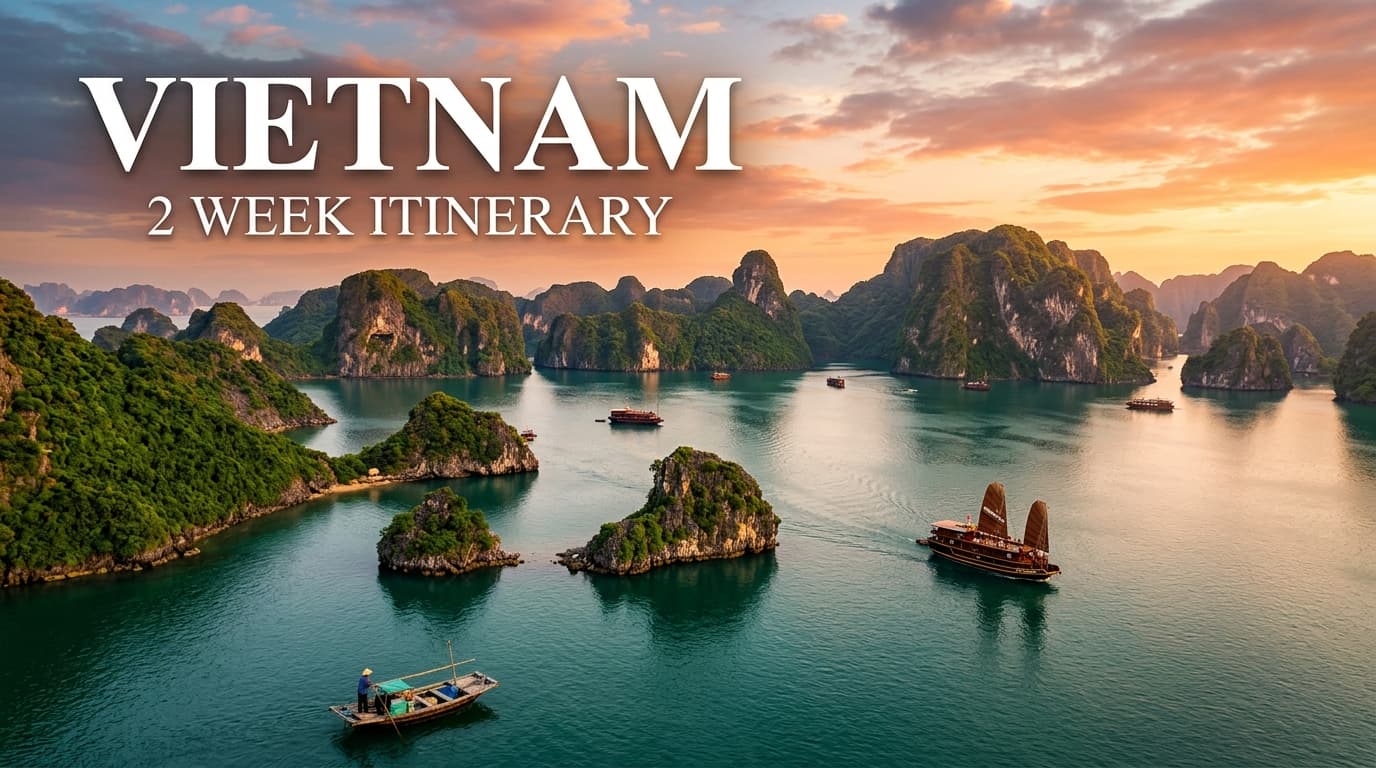
Vietnam in 2 Weeks: The Perfect North-to-South Itinerary
The ultimate 14-day Vietnam itinerary from Hanoi to Ho Chi Minh City. Day-by-day breakdown with transport options, costs in VND and USD, and honest advice on what to skip.
Plan Your Vietnam Trip
Book hotels, transport, activities, and get connected with an eSIM
Some links are affiliate links. We may earn a commission at no extra cost to you.